Thursday, June 10, 2021

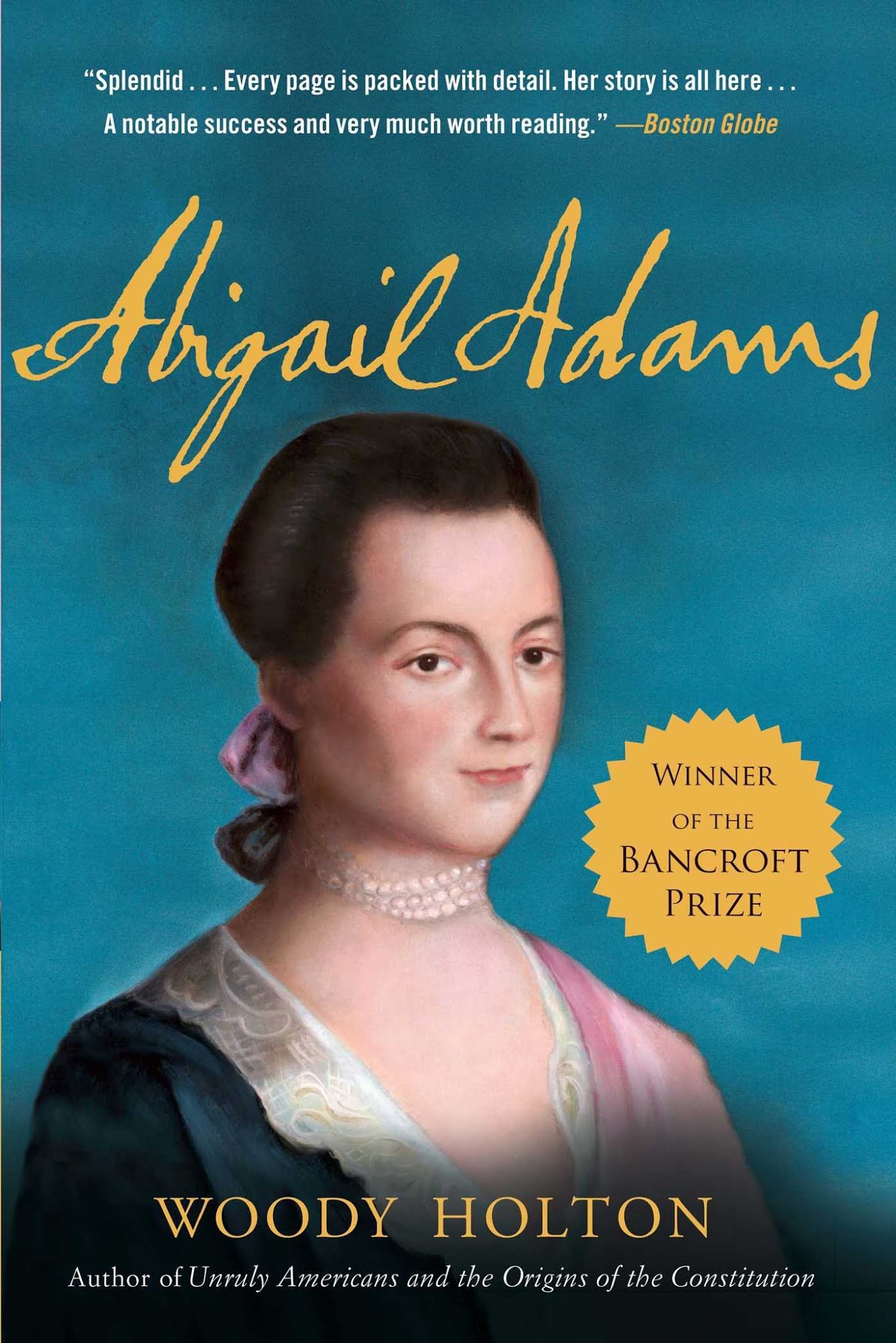
Abigail Adams by Woody Holton


Our book club decided to read Abigail Adams by Woody Holton. I love American History so it seemed right up my alley. Being that it focused on a woman made the book unusual. 

While I enjoyed getting to know her through her letters and other correspondence, the author seemed intent on relating each revelation to the extent to which she espoused feminist principles. While acknowledging that she was not a modern feminist, she definitely pushed back against a system designed to bring women and all their concerns under the authority of their husbands. Most notably, Abigail Adams had her own finances and invested her own money. While technically not legal, she made it work and became quite a financial wizard. She eventually left her substantial fortune almost exclusively to female relatives, thereby offering them a chance to do what she did and maintain financial independence.

More interesting than her "feminist" principles, I enjoyed getting to know her as a wife and mother. She and John spent most of their years apart. Yet they maintained a healthy and happy marriage. They watched their children grow, die, fail, and succeed. I related to this part so well. It's tough to have adult children whom you can only watch, but no longer directly influence. Although like any "good" mother, Abigail did call in favors when she felt it warranted to help her children. She particularly embarrassed John Quincy with that tactic. Yet her children seemed to love her and esteem her. None seemed to resent her interference.

I love the humanness of it all. She was a fierce patriot, sister, wife, and mother. Her interest in politics did not extend to necessarily wanting the vote for women or seeking higher office, but she definitely had opinions and believed women should be educated and literate citizens. She was fiercely loyal to John, who took a lot of abuse during his time. Yet she also kept secrets from him if she thought something would meet with his disapproval. Like any good wife, she knew exactly how to influence him and his decisions if she thought he needed prodding. Her constant correspondence with her sisters shows a loyalty that lasted her lifetime. They were always looking out for each other with Abigail playing the mother hen. But her role as a mom made the biggest impact on me. She so fiercely cared for her children. Although they were far away and communication was hard, she kept in close contact with each, offering advice and doing all she could to manipulate them to move closer to home. (That's where I relate.) As a mother, she took extraordinary steps to help her children in whatever way she could. Yet she often had to watch helplessly from afar. Marriages and jobs and disease distanced each of them at various times. I also loved that she was raising a child for almost her entire life. Her home was open and if a grandchild, niece, or nephew needed a place to stay, she would immediately volunteer. Time and again she offered her hospitality to all who would take it. It was remarkably easy to relate to her, her life, and her choices.

While the constant focus on the feminist aspect of her character was clunky at times, I truly enjoyed getting to know this opinionated, intelligent, and fiercely loyal woman. I think I would have liked her.

Wednesday, February 17, 2021

Live Not By Lies by Rod Dreher

I had just recently been introduced to the essay "Live Not By Lies" by Alexander Solzhenitsyn. This short essay, published just before Solzhenitsyn was exiled from Russia is so powerful that I needed to read it several times to fully imbibe it. When I heard that one of my favorite authors, Rod Dreher, had written a book of the same title, inspired by the essay, I had to read it. What a powerful read.

Dreher begins with a story of a little-known man, Father Kolakovic, who worked to prepare the Slovak Christians for the coming Soviet invasion. After World War II, he knew that the Russians would replace the Germans as an occupying force and felt the need to shore up the Christians in advance.

Dreher feels a similar mission in America. Not that America will soon be subject to the hard totalitarianism of Soviet Communism, but that America will soon fall under another destructive force he calls "soft totalitarianism." Following Kolakovic's dictum, Dreher wants Christians to "See. Judge. Act. See meant to be awake to realities around you. Judge was a command to discern soberly the meaning of those realities in light of what you know to be true, especially from the teachings of the Christian faith. After you reach a conclusion, then you are to act to resist evil." (p. 5)

Dreher believes that America, with its therapeutic, atomized culture, is a prime breeding ground for the soft totalitarianism he sees coming. We, as a people, are more lonely and separated than ever before. Hannah Arendt warned about the dangers inherent in that type of a society in the 1950s. "What prepares men for totalitarian domination in the non-totalitarian world, is the fact that loneliness, once a borderline experience usually suffered in certain marginal social conditions like old age, has become an everyday experience of the ever-growing masses of our century." (p. 31) As we have moved away from the original American dream of a virtuous citizen, informed by Scripture, free to live as he pleased within godly constraints towards a materialistic and individualistic view of happiness, we have also become exactly the type of society Arendt warned about. Our hyper-focus on our own, individualized experiences and our ability to interpret our own reality has fractured our society and left us vulnerable to totalitarianism.

This totalitarianism will not come from a gun, but from the tears of social justice warriors. These members of "ideological motivated moral communities" seek to enforce their sacrosanct beliefs, which give meaning and purpose to their own lives, onto the surrounding populace. (p. 60) As they see the world as a series of power struggles in the Marxian sense—oppressors vs. oppressed—they seek power to upend existing structures. Identity is the key to which camp one fits in. Various identities are definitionally oppressed while others are definitionally the oppressors. They do not seek actual justice; they seek power and domination. They have harnessed the most influential of social institutions in order to command the conversation and demand language reflect their point of view. Believing that words construct reality, and he who has power controls the language, they have latched onto language as a way to dominate. Say the wrong thing and it's labeled "violence." While actual violence is justified in the name of upending power structures. 

Dreher sums up where we find ourselves today:
In the West today, we are living under decadent, pre-totalitarian conditions. Social atomization, widespread loneliness, the rise of ideology, widespread loss of faith in institutions, and other factors leave society vulnerable to the totalitarian temptation to which both Russia and Germany succumbed in the previous century. 

Furthermore, intellectual, cultural, academic, and corporate elites are under the sway of a left-wing political cult built around social justice. It is a militantly illiberal ideology that shares alarm ing commonalities with Bolshevism, including dividing humanity between the Good and the Evil. This pseudoreligion appears to meet a need for meaning and moral purpose in a post-Christian society and seeks to build a just society by demonizing, excluding, and even persecuting all who resist its harsh dogmas. (p. 93)
However, Dreher is not writing to send the reader into despair. He spends countless hours interviewing those who lived in the times of Soviet totalitarianism to glean hope and way to stand athwart the coming onslaught. One dissident states, "You will be surrounded by lies—you don't have a choice...If you want to live in fear, or if you want to live in freedom of the soul. If your soul is free, then your thoughts are free, and your words are going to be free." 

First, we are to immerse ourselves in history. Not knowing history is a perfect way to atomize an individual. The person who does not know where he came from and what came before is isolated and vulnerable to lies. Religion is also necessary to connect individuals to one another so that a person is not left to fend for themselves in a world bent on lies. Truth in Scripture can be used to counter the deception propagated by a system bent on destruction. Faith, not reason, may be the only thing onto which a person can cling. Families are also indispensable in grounding individuals and passing on a heritage. Within a family, truth can be spoken free of fear. "It's no accident that every dictatorship always tries to break down the family, because it's in the family that you get the strength to be able to fight." (p. 148) Finally, an education, backed by and infused with Christianity and historical knowledge is the best way to prepare students for the coming darkness. People can survive the leftist totalitarianism only if surrounded by those who will hold him to truth and push out the lies.

Like in his book, The Benedict Option, Dreher recommends small, like-minded communities to harbor and shelter people from soft totalitarianism we are seeing today. He's not sure pastors will be up to the challenge. It's in small groups—families, schools, Bible study groups—that people will find the strength to stand up. "We desperately need to throw off the chains of solitude and find the freedom that awaits us in fellowship...Only in solidarity with others can we find the spiritual an communal strength to resist." (p. 181)

Spurn fear. We are free. Our souls can remain free if we choose to Live Not By Lies. Suffering and persecution can be withstood by a solid faith in God and in the Truth. We have no choice.


Saturday, January 23, 2021

84, Charing Cross Road by Helene Hanff

Our book club chose 84, Charing Cross Road by Helene Hanff to read for January. I'd never heard of it. 

Unfortunately, I think I got the wrong version. The one I picked up from the library was a play version, "Adapted for the Stage."I think, however, I got the gist of it.

One thing I didn't understand initially is that it is based on actual letters between the author, Helene Hanff, and a bookstore in London. The play opens with Frank Doel, the procurer of books for the "antiquarian bookseller" reading a letter from Hanff, a poor struggling writer living in New York. The first letter is dated October 5, 1949. She is requesting "three Hazlitt essays" as well as a Latin Bible. He promises to do his best to fulfill her order and ship them out.

What follows is the slow, and all-too-real, development of a transatlantic friendship centered on the appreciation of fine, largely out-of-print, books. Not realizing the letters were real, I expected the story to go in certain directions. Surely a love story would develop or some major crisis would erupt, or each book requested by Helene would either foreshadow or relate to some circumstance in her life. None of that happened. Real life simply doesn't happen that way.

Throughout the book, Helene expresses a desire to cross the ocean and meet those who share her love for fine literature. Alas, it is not to be. As Helene journeys through life, becoming increasingly successful, she is also thrown expensive curveballs, which constantly frustrate her ability to visit. As the years pass, she remains single, moves and changes jobs, various clerks at the bookshop marry and move on, some die, and finally, Frank Doel passes away. The last letter is from his wife, dated January 8, 1969. The twenty-year correspondence is ended. The final moments of the play depict Helene on a plane to London. 

It is certainly a charming book, told in a lovely manner. My only criticism is that I wish it had a bit more of a story. I would love someone to write a similar book, but include a plot. However, watching two people develop a long-term, platonic friendship over a shared love of beautiful literature is also a worthy endeavor. 


Sunday, January 3, 2021

Liberty or Lockdown by Jeffrey Tucker

I was reading an article recently that recommended this book, Liberty or Lockdown by Jeffrey Tucker, as the best thing on our current Covid response. So I ordered it right away. It's a collection of essay published throughout 2020 at the American Institute of Economic Research. Some have not aged well, as most were written before September. The principles, however, hold. 

Lockdowns do not deter a virus. Trading liberty for the promise of safety nets us neither. 

Although I wouldn't say the book is a top ten or anything like that, it's worth the read. It's short and eminently readable. The first few essays alone are worth the price of the book.

The American Institute of Economic Research is free-market think tank, and as such subscribes to the theory of diffused knowledge being the best way to gather all the relevant information. Therefore, when the Covid virus hit our shores, the best thing would have to been to diffuse knowledge and let the aggregate determine the best course forward. Of course we know that is the opposite of what happened. The original sin in the Covid response was limiting knowledge and therefore seeking to avoid a panic. To this end, testing was only to be done at the CDC/FDA direction. Private companies were not allowed to develop and administer their own tests. Knowledge became a premium commodity available only to a select few if at all. Lack of knowledge coupled with the call to, "Do something" led to the hysterical and irrational initial responses. 

Ironically the knowledge we needed actually existed. Humans have been dealing with pandemics for all of history. "Somehow in the 21st century, we find ourselves in the awkward position of having to relearn the basics of immunology that everyone from 1920 to 2000 or so seemed to understand." (p. 20) There are only two ways to defeat a virus: to develop immunity through contracting the disease or through a vaccine. Somehow, the decision-makers in our society decided that they alone could pioneer a new way forward, which involved lockdowns and quarantining healthy people. We forgot what we knew. In thinking we were so much smarter than those of the past, we made ourselves stupid. "It was pure speculation that lockdowns would suppress this virus, and that speculation was based on a hubristic presumption of the awesome power and intelligence of government managers." (p. 24)

As one country after another copied whatever the previous leader did, the arrogance metastasized. Now all efforts went toward propping up a policy based on nothing and accomplishing nothing. To intentionally hurt people by destroying their businesses, throwing them out of work, decimating their mental health, stealing educational opportunities, and shredding the fragile social fabric that holds societies together takes a special kind of callousness. "The more pain you inflict on people, the worse of a person you become. Power is dangerous even when not used, but deploying it brutally and pointlessly rots the soul." (p. 33) Therefore the big lie becomes necessary. The leaders must double-down to justify their policies. 

Other than the obvious damage the Covid response has had on the world, Tucker makes an even more compelling point, "Once you lock down a population by executive fiat, based on obvious ignorance and fear, you send a signal that nothing much matters anymore. Nothing is true, permanent, right, wrong. Might as well tear it all down. You literally unleash Hell." (p. 34) Therefore the riots and rage seen all over the country is the predictable, and actually rational, response. "If we stay on the present course of hiding and futilely trying to suppress the virus, wee will end up making all of society poorer both materially and spiritually and also delivery a dangerous blow to our biological health." (p. 127)

The response to the Covid pandemic has not only failed to mitigate the effects of the disease, it has made it far worse. We now suffer not only the effects of the virus, but the effects of the cure. "From early in the lockdown days, it became clear that this crisis would not make us 'come together' and be 'better people.' It would not be like 9-11. Instead, it would shatter our lives and make us worse people. We would turn on each other, engage in dramatic deeds that would hurt and harm people we like and love, and push our political agendas ahead of basic humane values." (p. 176)

It's a good, yet depressing, read.

Tuesday, December 1, 2020

Northanger Abbey by Jane Austen

I love Jane Austen. Her Pride and Prejudice is one of my favorites. I can't say I loved Northanger Abbey.

It's fairly typical Austen: love-sick girls, balls, fancy parties, rich and upper middle class tension, marriage as a vocation, etc. Although I don't think Austen can be boiled down to all that and her themes are generally much deeper, this book only seemed to have the elements without the themes. 

Maybe I'm missing something. 

Young Catherine Morland has few prospects in her home town. When asked by a wealthy couple to join them in a six-week trip to Bath, she jumps at the chance. Initially failing to establish much of a social life, she eventually falls in with a group of young people in the Thorp family who promise excitement. They turn out to be false friends and almost lead to her undoing, Thankfully, another family is there in the background to swoop in and rescue poor Catherine from the clutches of this shallow group. 

Despite Catherine's immaturity and grand romantic dreams, she is welcomed by the Tilneys and invited to join them at their home, Northanger Abbey. Catherine is enraptured at the thought of spending time in an old Abbey, with it's promise of ghosts and intrigue. She is disappointed to discover an ordinary, loving family. She almost loses all of them when the Thorp family's misdeeds link unfavorably back to Catherine. But good wins out. Catherine marries Henry Tilney and his sister Eleanor becomes Catherine's new sister. 

The book is full of exaggerated characters and scenes. I know Austen was trying to make a parody of the day's gothic novels, but not having that context, just made it seem like a bad romance. I wouldn't say it's a "must read." Perhaps that reflects poorly on me. 


Saturday, November 28, 2020

Life and Death in Shanghai by Nien Cheng

Our book club decided to read Life and Death in Shanghai by Nien Cheng. I had read a biography of Mao years ago, and so had some familiarity with this time in Chinese history, but this account was such a different perspective, it was well worth reading. 

Nien Cheng is a widow who worked for Shell in China after her husband passed away. Although initially excited about the changes the Communists promised, that hope soon gave way to reality. Caught up in the Cultural Revolution, her life was completely destroyed. She was imprisoned, tortured, her daughter murdered, and yet eventually she was vindicated. Her only crime... well that't the thing. She never committed a crime. Her existence as a relatively wealthy Chinese was her crime. Refusing to "confess" and so reduce her punishment, Cheng stood bravely when almost none of her peers resisted the enormous pressure. 

What I loved most about the book was the insight into human nature. Government officials and common people could so easily go along with the the party line, no matter that it shifted constantly in contradictory ways. All that mattered was self-preservation. While it's certainly discouraging to see the lengths people will go to delude themselves, it's also refreshing to see truth so graphically displayed. Humans are fallen and sinful and will bask in lies if lies will promise safety. We know that eventually truth wins out and the safety offered is a chimera, but in the meantime, humans will love the dark if the dark promises one more day. Unsurprisingly, Cheng is a Christian, so she had the hope of another world and a rock on which to stand. Although she only mentions her faith from time to time, I can't help but believe that was the difference between her and those who folded under the pressure. 

Even today, I'm reminded that Christians have not been given a spirit of fear. We are to stand, safe in the knowledge that truth will prevail and this is not our home. Unfortunately, that time on earth may not always be pleasant and may even be painful. But the story does not end there.

Saturday, November 7, 2020

Blood Brothers by Elias Chacour


We read Blood Brothers by Elias Chacour as part of our Book Club. It's not one I would necessarily have chosen. 

That being said, I'm glad I read it. I have friends who take the Palestinian and Palestinian Christian side against the Israeli Jews often and this is the kind of story they refer to as the basis for their support. 

The story begins with an edenic childhood in Palestine interrupted one day be evil Zionist who take the land and refuse to let the townspeople back in. No reason is given other than the Zionists are evil. 

Chacour takes pains to point out that growing up he was always taught to love and respect the Jews as "blood brothers" to the Palestinian Christians, and he is careful to distinguish the Jews from the Zionist.

The families are largely thrown to the wind as refugees in nearby towns. Despite attempts to return or to exist peacefully with the Zionists, they are never allowed back in. 

Finally, Chacour is sent to a boarding school and eventually to seminary. His first job is in a desperately poor town with a history of internal division. The best part of this story is when he locks the congregants in the church and demands reconciliation. From this he gets the idea that he can reconcile Jews and Palestinians through peaceful protests and demonstrations. 

This becomes his main focus, especially later in life. 

The biggest disappointment in the book is that the Jews are treated as cartoon characters and despite the distinction between them and the Zionists, it's not clear there is a distinction. The Jews are only portrayed as hateful and irrational, although some are willing to see reason and lay down their hatred. Terrorism is almost never mentioned except as extremely rare occurrences by those who were not raised in the loving bosom Chacour experienced. And for his peers acting violently, he dismisses that with a "what do you expect" attitude. 

Elias Chacour seems to be a genuine Christian with a genuine commitment to the Gospel, but I think he is still blinded by Palestinian identity. He sees the Jews as usurpers. Life was perfect before the evil Jews invaded. If they had just stayed a tiny minority and let the Palestinians continue in their ways, there would be no conflict today. This narrative ignores the large events taking place outside his tiny town. He has his limited perspective and it seems like he is unable to provide a larger view.

One thing that I noticed time and again was that although it appeared the things I could research were factually correct, his take on them is sometimes misleading. His story about his village is true. In fact another village experienced the same thing. However those two villages stand out as aberrations and are frequently mentioned in the horrors of Israel. He makes it sound like his small village is one of myriad villages experiencing the same thing. And he never hints at any kind of reason for the takeover of his village besides pure evil. I have no idea if the Israelis saw some sort of strategic purpose in taking the villages. I assume some kind of reason was behind it, even if not communicated to the people. That is not to justify it, but these kinds of horrible things happen in areas under distress. Hundreds of innocent German towns were bombed by the Allies in WWII. Life in a war zone is awful. 

Other stories he told put the worst spin on controversial events. I researched a couple and the general thinking seems to be it could have happened that way, but no one knows. For example, he accuses the Jews of terrorizing Iranian Jews so that they would immigrate to Israel. Some pointed out that this was a story floated by Iran, but it makes no sense from an Israeli perspective. They were already struggling with the immigrants pouring into the country. Chacour's ability to take one side in an argument, as long as it makes the Jews look evil, certainly damages his credibility. 

The reason I'm glad I read this is so that I could see what those who defend the Palestinians see. If this is the best evidence for the maltreatment at the hands of the Israelis, I remain unconvinced.