Showing posts with label political. Show all posts

Saturday, May 16, 2026

The Quartet by Joseph J. Ellis

I'd had The Quartet by Joseph J. Ellis on my list for awhile. I don't even remember where the recommendation came from. But I am so glad I read this book. 

Obviously, I know a thing or two about American history, but this book brought some events at the time of the Founding into sharp relief and connected dots I had not. 

It's contention is that Washington, Madison, Hamilton, and John Jay together, through their sheer force of will, reimagined what the American Revolution was about and shaped the American Constitution to reflect their will. It's pretty compelling.

What was clear to all was that America stood on a precipice. What would it be now that it had won its independence from Britain. That single goal united all thirteen colonies, but they were united by little else. 

In fact, all the struggles Washington faced to fund the army through a recalcitrant Congress presaged the even harder battle after the war was won. Each state truly saw themselves as independent states. They united to defeat the British, but how to pay for that or how to run a united country afterwards was not a consideration. They had no desire to be the United States. Once the war was over, they did not even see the need for a functioning Congress. Of the delegates elected after the war, less than half even bothered to show up. The fact that we did not have an Executive or Judicial branch made perfect sense. Why would these thirteen, independent states need either. After all, hadn't they just thrown off an executive and judicial system which had tyrannized them? The Articles of Confederation, which controlled the colonies during the war, were intentionally weak, and apparently probably temporary. 

Washington recognized right away the trouble the nation was in. He despaired that he had fought for an independent United States just to see it quickly devolve into myriad self-interested, squabbling petty kingdoms. As long as each state retained its sovereignty, they did not think about common commerce, paying debts, military protection, or foreign policy. Any attempt to promulgate a stronger central government was derided as a return to the monarchy they had just thrown off. Yet Washington clearly saw the anarchy this opened America up to. Small states would be helpless in the face of an unpaid and angry military. States would eventually war with each other over boundaries, navigation rights, etc. And all would be sitting ducks to European powers just waiting for the dust to clear. 

John Jay went to England to negotiate the peace treaty after the war. So ineffective was the Continental Congress he left behind that he had no clear instructions or even a way to actually ratify the treaty he finally negotiated. Even when he came back with a phenomenal acquiesces from the British giving Americans all the land east of the Mississippi, the states' suspicions of each other prevented us from taking advantage of it. Unbelievably the North and South already looked at each other as competitors. Since the treaty would open up so much heretofore unclaimed land, both believed the other would use it to their disadvantage. Washington, a surveyor, knew the unbelievable gift the land was and was horrified that no one else seemed to see it. Jay saw what Washington saw and knew that a collection of infighting states would lead to one of the biggest missed opportunities in history.

Because Hamilton was not raised in a colony, he had no prejudicial connection to any one territory. In fact, he clearly saw the need for a united nation and the promise of political and economic advancement on the table. He also believed the war was about independence, not the overthrow of a particular type of governing system. He might have been ok returning to a monarchy as long as it was an American monarchy. He believed in America. He believed in the United States. He had no patience for The Thirteen Headstrong Squabbling States. 

But even with these heavy hitters, America owes all to Madison. It was he who saw most clearly the need for a central government to unite the colonies. Despite the fact that he felt a strong connection to his native country, Virginia, he worked tirelessly behind the scenes to push and prod the biggest players to come together to write a new governing document that would unite the disparate states into one country. A true politician, he waited until the moment was right, after Shay's Rebellion scared men like Washington into action. Although Hamilton jumped the gun in his excitement, calling a convention to "revise" the Articles, Madison politicked behind the scenes making sure delegates amenable to radical change would be the ones to show up. 

Then he developed a plan: The Virginia Plan. It gave each state power based on population, which coincidentally Virginia excelled in, and it gave the central government control over states' laws, meaning Virginia control over states laws. He lost in both arenas, rightfully so. But, he sparked a conversation about how to maintain the states' role in a federal government. Myriad compromises meant the line between state and national power would be blurred again and again. It would be up to future generation to find that line, but the seed was planted. Together these four laid out the principles that the Revolutionary War should have been fought for, but honestly wasn't. 

The book does a fantastic job of showing how close we came to winning our independence only to lose it again due to our own stubbornness, pride, and stupidity. Without these four men, we do not get the United States of America. These men saw with an exceptional kind of clarity the opportunity being handed to the states, a kind of clarity other mere mortals did not have. Through sheer force of will they created the nation we have today.

Friday, July 25, 2025

The Face of Battle by John Keegan

Somewhere I saw this book highly recommended as one of the best books on war ever written. So I decided to give The Face of Battle by John Keegan a try. 

I'm not a huge fan of war books, but this one was interesting. 

He decides he will tell military history differently than it has been done in the past. He wants to look deeply into the face of the men who faced the battle. He states early on that he intends "to discuss wounds and their treatment, the mechanics of being taken prisoner, the nature of leadership at the most junior level, the role of compulsion in getting men to stand their ground, the incidence of accidents as a cause of death in war and, above all, the dimensions of the danger which different varieties of weapons offer to the soldier on the battlefield." (p. 77) He uses three battles as jumping off points for these discussion: Agincourt, Waterloo, and the Somme. He presents them in chronological order and also in order of magnitude. By starting with the much smaller, earlier battle of Agincourt, he provides a helpful place to compare later battles.

One plus, I got to read about battles I have only cursory knowledge of. And, he made it interesting.

He begins with the medieval battle of Agincourt on October 1415. It a small (by modern standards) battle that lasts only one day. It involves the French and the English and occurs at the end of the Hundred Years War. The killing and violence are horrifying, but Keegan makes note of the three most motivating factors: alcohol, King and religion, goods and glory. Although he thinks the last is probably the most important. At a time when even the battle-hardened looked to their priest for permission to kill, knowing that God and the King fought by your side was highly motivating. It didn't hurt (apparently) to be drunk, either. But knowing you would be rewarded in this life pushed men into a level of violence our modern sensibilities simply cannot comprehend. 

Then he moves to another French and English battle, Waterloo, on June 18, 1815. It's scope is much larger than the battle of Agincourt, covering over 2 square miles.  Despite the Duke of Wellington's desire to dismiss any literary or historical accounts of it, the battle looms large in the imagination. And it's no wonder. 

"For the first time in the history of the British army, each veteran of the battle was awarded a commemorative medal. He was to be known as a Waterloo Man and his single day of service on 18 June1815, was to count two years pension. This alone was sufficient to convince even the most unimaginative private soldier that he had survived an extraordinary event; officers were in no doubt of it from the moment the battle closed..." (p. 117). 

When Napoleon returned to France after his exile and the restoration of King Louis XVIII, the powers of Europe decided he would not return to power. They mustered four large armies to meet him, made up of the Austrians, Russians, Prussians, Belgiums, and an Anglo-Dutch army formed on a core English army. Napoleon, seeing the writing on the wall, decided to attack on of the first arrive, the Belgiums. After quickly dispensing them, he turned to the Anglo-Dutch army and attacked head on. That's exactly what the Duke of Wellington assumed he'd do. Although he initially tried a feint to the left, the battle commenced in the middle. The battle is generally considered to have five phases, although that was not obvious to the participants. Obviously in a battle this size the descriptions of the fighting and the wounded stagger the imagination. But once again, the French are dispatched and history moves on.

Moving forward into the future, Keegan describes the battle of the Somme. This is the horrifying trench warfare of World War I. Suffice it to say that this battle encompassed a much larger geographic location and lasted much longer than the others. 

From AI:

Core Themes of Keegan’s Analysis
  • The Brutality of Industrial Warfare: Keegan emphasizes how modern machinery—specifically automated machine guns and high-explosive artillery—turned the battlefield into a mechanized slaughterhouse that completely overwhelmed human endurance. [1, 2]
  • The Failure of the Bombardment: He details how the preliminary British artillery barrage failed to cut the thick German barbed wire or destroy deep underground concrete dugouts, leaving the defending German troops intact and ready. [1, 2, 3, 4, 5]
  • The Human and Institutional Cost: Focusing on July 1, 1916, Keegan notes the devastating loss of 60,000 British casualties in a single day. He highlights the tragic optimism and courage of the volunteer "Pals" battalions who advanced into certain doom. [1, 2, 3, 4]
  • The Role of the Officer Corps: Keegan explores how the British public-school ethos shaped junior officers, maintaining a fragile sense of duty and social cohesion even as entire platoons were wiped out. [1]

For a book about warfare, I liked it far more than I thought I would. Unfortunately I waited too long to summarize it and didn't want to actually re-read it to get this summary. Ergo the AI addition at the end.

Thursday, September 26, 2024

Lincoln and Douglas by Allen C. Guelzo

One of my former students, Will Rhodes, who attends Princeton, gave me this book, signed by his professor and my favorite Lincoln scholar, Lincoln and Douglas by Allen C. Guelzo. What a delight this book was. 

Of course I'm familiar with the Lincoln/Douglas debates. I have read most if not all of them. But this book, following the pair from stop to stop really brought it alive for me. 

It begins with Lincoln's frustration at what Douglas was claiming on the campaign trail for senator of Illinois. Lincoln began to follow him and rebut his claims soon after Douglas' speeches. Annoyed, and definitely not in his best interest, Douglas agrees to formally debate Lincoln at each of the seven remaining campaign stops. 

Douglas is a very popular politician and his doctrine of "popular sovereignty" is popular as well. The idea that slavery should be voted up or down in a new territory and state appeals to Americans' democratic disposition. But Lincoln sees the end of this argument: slavery will exist, eventually, in every state in the union. 

Because the 17th Amendment has not yet been passed, senators are chosen by the state legislators. How this plays out practically is that men, like Douglas, campaign, not for themselves, but for legislative candidates pledged to support his bid for senator. It is, de facto, a popular vote on the senator, using the institutional constraints of the Constitution. While it is technically incorrect to say they are "running" for the Senate, it is arguable that that is exactly what they are doing. Lincoln, however, is a very dark horse in this race. He was a one-term member of the House of Representatives and a local lawyer. He is unknown outside of his home district and is not a national figure, by any means. 

These debates will change all that. 

With the advent of the new, anti-slavery Republican Party, the political ground was shifting rapidly. Whigs were in disarray and their vote is up for grabs. Henry Clay, the quintessential Whig is Lincoln's political hero, and his only hope is to persuade them that he, and the Republicans, are not rabid abolitionists, but align with the Founders. His opponent must simply seem reasonable. One thing I loved about his book is to discover how the political landscape is not so different from today. We think we are polarized now and mythologize some distant past where politics was civil and gentlemanly. That is a past that never existed and never will. Politics is bloodsport and Lincoln understood that better than most. 

In June of 1858, Lincoln was nominated to represents the Republicans in the Illinois Senate race and delivered his "House Divided" speech. Recalling Jesus' admonition that "a house divided against itself cannot stand," Lincoln posited that an America, similarly divided on the question of slavery, could not stand. To his detractors, this sounded like a call for civil war. To his admirers, he was finally asking that the question be answered, not in political or economic terms, but moral terms. Americans must answer whether slavery was right, and should therefore be national, or wrong, and should therefore be put on a path towards extinction. Lincoln believed he stood with the Founders and answer that slavery was immoral. But the intervening years had given way to political solutions and Americans, Lincoln believed, had forgotten the question. 

Guelzo does a great job uncovering the political consideration, and they were myriad, that Lincoln faced seeking to upset Douglas. He refers to letters and newspaper articles describing the in-the-weeds political needle Lincoln had to thread. That part is interesting and new to me, but what really fascinated me was the flow of the debates as they moved from town to town. While much was repeated, a new emphasis and nuance was introduced at each stop, culminating in the final, and what I believe to be the crux of the argument, debate. 

The first debate took place in Ottawa. While it was friendly territory for Lincoln, Douglas began by describing the Republican Party as a party of rabid abolitionists and challenged Lincoln to defend each of the planks of their Illinois State Convention platform. Of course each was framed to inflame the passions of the audience. Douglas referred back to the "House Divided" speech, implying Lincoln wanted war to settle the issue. In fact, Douglas stated that it was he, not Lincoln, on the side of the Founders. Weren't they the ones who "made this Government divided into free State and slave States, and left each State perfectly free to do as it please don the subject of slavery"? And as for the Declaration's claim that "All men are created equal"? Obviously that meant all white men are created equal. To read it any other way was to say the blacks and whites were equal in every way. This horrified the crowd. What Douglas left out was any mention of the already failed popular sovereignty doctrine in "bleeding" Kansas and the results of the Dred Scott Supreme Court case, which guaranteed slavery free passage anywhere in the nation. 

Unfortunately, Lincoln took the bait and proceeded to spend his time defending himself against Douglas' charges rather than make the moral case against slavery. He said he never signed on to the Illinois Republican platform. He did not believe blacks were equal in every sense, just as fellow humans. He did not want to abolish slavery everywhere, but simply keep it where it was. He tried to argue that Dred Scott had effectively made popular sovereignty moot. In fact, Lincoln argued, the decision was all part of a vast conspiracy to extend slavery nationally and, like any good conspiracy theorist, he tried to show that all evidence for or against the conspiracy only pointed to its validity. The crowd wouldn't hear it. They simply heard he was anti-war in the "good" war (Mexican American) and pro-war in the bad one (civil war) and wanted to give black people all the privileges currently given only to whites. 

In this debate, it's hard to call a "winner." Douglas went on a rabid attack and Lincoln spent his time on the ropes defending himself. Yet he did defend himself. Against the nation's best debater, that seemed like a win. 

The second debate took place at Freeport. Once again the crowds showed up for what promised to be a robust political spectacle. This time Lincoln spoke first. Lincoln began on the defensive, stating all of the queries Douglas had posed at the last debate and answering them all again. In fact, he answered them in such a way that even his admirers felt he had given away the entire Republican doctrine. But as a lawyer, Lincoln understood that it's better to give up what you cannot keep and save one irrefutable argument in your pocket. This was his belief that only Congress had the right to answer the slavery question in the territories. This went directly against popular sovereignty and Dred Scott. Then Lincoln went on the offensive asking Douglas to defend his positions in light of Dred Scott which ruled that any new territories could not lawfully keep out slavery. Lincoln, through a series of questions, walked Douglas through to the only logical conclusion: that Douglas would be ok with all new territories entering the Union as slave territories and that there was nothing to be done about it. This seems to have very much concerned the people of the free state of Illinois. He also made clear that what Douglas claimed to be the platform of the Illinois state Republicans was actually that of another organization and that Douglas had no right to hold him accountable to it. He claimed Douglas was careless in his facts and therefore could not be trusted.

Douglas responded by breezing past Lincoln's question, reiterating his popular sovereignty mantra, once again, as if Dred Scott had not made it moot. He then went on to disparage Lincoln as a "Black Republican," and implied that Lincoln stood for mixing of the races on every level. Again and again, Douglas plays the race card and appeals to the bigotry of his audience. 

The most important part of this second debate was Lincoln's second question to Douglas at Freeport, "Can the people of the United States Territory, in any lawful way, against the wishes of any citizen of the United States, exclude slavery from its limits prior to the formation of a State Constitution?" The key word is "lawful." Lincoln knew the Dred Scott decision had already answered this question with a "no," since slaves were property and could not be excluded based on the territories' borders. But Douglas could not afford to acknowledge this. He wanted to straddle the fence with his "don't care" philosophy towards the legality of slavery in any particular state. This question would pursue him time and again at subsequent debates. This is Lincoln playing the long game. He knew in 1858 that Douglas' answer might satisfy the people of Illinois, but he knew Douglas had presidential ambitions and that question would destroy any chance he had on the national stage in 1860. Guelzo believes Lincoln was also desperate to deny Douglas a place at the top of the Republican ticket. He could see Douglas believing he could unite northern Democrats with Republicans and win in a landslide. Lincoln saw that as the death of the Republican Party. 

The third debate took place in the southern town of Jonesboro. In this very poor and largely illiterate town, Douglas had a hard time connecting and certainly had no energy to feed off of. Although the area definitely leaned pro-slavery, Douglas spent a good deal of time on Republican inter-party weeds before finally getting to his main point about Lincoln's supposed desire to give black people all the civil rights enjoyed by whites. He reiterated that it was he, not Lincoln, upholding the Founders' intentions to let each state decide the slavery question for itself. 

Lincoln agreed that the Founders had indeed left slavery up to the states, but disagreed that they intended that situation to prevail. He pointed out evidence that the Founders had always hoped to see slavery on a path to extinction. He also tried, with little success, to tie Douglas to some Democratic positions that sounded on slavery exactly like Lincoln's. Lincoln denied that he was agitating for war, but did remind the people the closest they got to war was the perpetual question of slavery with the addition of each new territory. Lincoln did, however, add a question concerning a federal "slave code" that would ensure the property rights in slavery in any territory. This, like the second Freeport question, was a damned if you do, damned if you don't question. Douglas could not concede any federal right to regulate slavery in the territories, because they could make it legal everywhere. He also could not say the federal government could protect a state in its anti-slavery legislation either. Douglas simply reverted to his magical panacea of "popular sovereignty." 

No clear winner emerged from this southern excursion, but Lincoln had little to lose in unfriendly territory anyways.

The fourth debate took place in Charleston, a Whig stronghold. While hating slavery, they also abhorred the idea of equality in civil rights. Lincoln was therefore forced to clarify that he did not believe blacks were equal in any way other than natural human rights. This marks a low point and is the basis for declaring Lincoln a racist. He certainly panders to a racist crowd, trying to thread the needle between full acknowledgment of the humanity of blacks and full social equality. 

Douglas responded with his own conspiracy of the ways in which Lincoln and the Republicans were seeking to make the Whigs abolitionists. He knew this to be an anathema. He also rejected Lincolns forceful claims to only want human rights for blacks by saying Lincoln opposed Dred Scott, which made citizenship illegal for blacks. He therefore implied that Lincoln must be for citizenship for blacks and all that entails. 

While Lincoln wanted to argue that he opposed Dred Scott because it put the slavery question in the hands of the Supreme Court, arguing for the states to decide on the civil rights of black people edged a little too close to Douglas' popular sovereignty doctrine. He also had to spend time diffusing Douglas conspiracy charges of "abolitioning" the Whig party. But Lincoln scored a few points. He made Douglas look inconsistent on his "don't care" policy regarding slavery by showing Douglas had actually voted against legal provisions that would have helped the anti-slavery movement. He used the morality of slavery as a cudgel against Douglas and reiterated that the best and least harmful path forward was the one the Founders advocated, an inexorable path to extinction. And, most importantly, he stood his ground. The people came to see Lincoln as the equal of the "Little Giant" Douglas when it came to the debates. 

The fifth debate took place in Galesburg, friendly territory for Lincoln. Plus Douglas had been wearing himself out physically, battling bronchitis, and was becoming more and more dependent on the bottle. He trotted out his tired arguments on popular sovereignty and tried to hold himself out as a man willing to stand up to both pro- and anti-slavery forces and fight for the will of the people. But he lacked energy and enthusiasm.

Lincoln, in contrast, came out swinging. Lincoln dismissed most of the speech for what it was, simply the same things Douglas had said at every stop. He would focus, however, on the Declaration's claim that "all men are created equal." Lincoln pointed out that one could search in vain for any evidence at all that the Founders only intended it to apply to white people. He pointed out that the author, Jefferson himself, "trembled" when he considered that God is just and that slavery would never gain His favor. Here Lincoln became quite elevated indicating that if slavery is right or wrong based on a majority's opinion, then morality itself is on the ballot. If Douglas continued to willfully blind himself to Lincoln's natural law argument that black and white people are inherently equal as humans, then Douglas would bring down the entire moral edifice of right and wrong. If Douglas persisted in claiming he "don't care" whether slavery is voted up or down, and refused to recognize the moral degeneracy of slavery, then Douglas had no right to speak of "right" and "wrong" in any context. Right and wrong then became entirely dependent on the mood of the electorate. Lincoln ended by saying that the only way to put the immoral practice of slavery on a path to extinction was to elect Republicans. 

In his rebuttal, Douglas found his fire. He rabidly called out Lincoln for hypocrisy, literally foaming at the mouth and shaking his fist. He said Lincoln was not for equality in unfriendly territory like Jonesboro but now claimed he was for equality in friendly Galesburg. He angrily defended his honor against Lincoln's charges of lying about the Republican resolution brought up in the first debate. He claimed that Lincoln, with his opposition to Dred Scott, invited mob rule. 

The debate ended with a defeated and deflated Douglas, and a Lincoln who could now see a path forward on offense. 

The sixth debate took place at Quincy, on the border of slave state Missouri. Lincoln spoke first, coming after Douglas with a vengeance. He called Douglas a liar for continuing to pin resolution on him that Lincoln had not agreed to; he called Douglas a dodger for refusing to see the logic of Dred Scott and the way it demolished his popular sovereignty doctrine; and he called out Douglas for willfully refusing to debate on the moral principle of slavery and obfuscating instead with racial rhetoric. Lincoln made it exceptionally clear that the reason slavery presented a fight every time it came up was because Americans knew it was a moral question: some believed it to be wrong, the Republicans; some believed to be right, the Democrats. Lincoln posited that that was the only question up for consideration. Was slavery right or wrong? Was it a refutation of the Founders and the Natural Law upon which the nation had been founded or was it simply another political position to be left to political institutions? The audience could join with the Republicans and at least acknowledge it as a moral wrong, and leave the "then what" to the future or join with the Democrats and deny even the immorality of the institution. 

Douglas, addled in in poor form, continued to deny slavery was a moral issue. He agreed with Lincoln that truly didn't care about the morality of slavery. For him all the agitation that came with the slavery question was promulgated by abolitionist like Lincoln. He continued to claim he was directionally correct in tying Lincoln to the resolutions put forth in the first debate, if not factually correct. He defended his honor against Lincoln's charges of lying and being part of a conspiracy to extend slavery to the whole nation. He seemed genuinely unable to understand Lincoln's point about Dred Scott's protection of slavery in any territory, and by extension, any state. He simply could not see why a territory or state could not disallow slavery as they would any other property, like alcohol. 

Lincoln responded that the only question under consideration was, once again, the morality of slavery. ALL opposition to the institution stemmed from moral opposition. The Founders opposed it on moral grounds and put it on a path to extinction. Had not the cotton gin made it economically feasible, it would have remained on that path. It was Douglas, not Lincoln, who departed from the American ideal. To the charge of changing his message to suit his audience, Lincoln offered his notes from each debate and speech he'd given to show that his message remained the same. 

The seventh and final debate took place in Alton. Douglas began, looking quite haggard from the exertions and the alcohol. Douglas harkened back to the "House Divided" speech and once again portrayed Lincoln as a war-monger. He continued to paint Lincoln as a man who believed in civil and social equality between the races. He accused Lincoln of slandering the Founders in refusing to accept a permanently half-slave and half-free nation. He pointed out that he had broken with the Democrats over slavery numerous times, but that Lincoln had refused to reject the position of the extreme abolitionists. Lincoln simply listened to the charges he had heard again and again. Lincoln wanted civil war. Lincoln was a n_____ lover. Douglas was the true hero who stood up for the rights of the people.

Lincoln stood and made a joke that watching Douglas distance himself from the pro-slavery aspects of his party was like a battered wife watching her husband fight off a bear: she wasn't sure who to root for. 

Then he got down to business. Douglas had claimed that Lincoln refused to acknowledge the authority of the Supreme Court by rejecting the logic of Dred Scott. Lincoln said that was nothing compared to Douglas' willful misrepresentation of the Declaration of Independence. Lincoln quoted from the Great Compromiser (and notable Whig) Henry Clay to the effect that all men are created equal, but that does not always imply social and civil equality (i.e. women and children were not civilly and socially equal to men). In opposing the "House Divided" speech, Lincoln put Douglas on the side of satan disparaging the Bible, as it was biblically inspired. Lincoln reiterated the clear evidence that the Founders believed they had put slavery on a path to extinction. Pulling the rug out from Douglas' popular sovereignty argument, Lincoln stated that he no problem with the principle if contained to subjects over which the majority had the right to decide. He simply believed morality fell outside that boundary. And he claimed everyone listening knew that. Finally Lincoln boiled his entire argument down to one statement, "The real issue in this controversy--the one pressing upon every mind--is the sentiment on the part of one class that looks upon the institution of slavery as a wrong, and of another class that does not look upon it as a wrong." (p. 265) All practical questions of how to deal with the institution as it existed must be pushed aside until that fundamental question could be answered. 

In fact, argued Lincoln, the arguments for slavery were identical to the arguments for a king, rejected by our Founders. Slavery did not just dehumanize black people, it introduced the idea of a hierarchy among people. Worse, according to Douglas, this hierarchy could be determined by a vote! "Those who deny freedom to others, deserve it not for themselves, and, under a just God, can not long retain it" (p. 267). Thus the apex of his argument was formed. After starting out on the defense, Lincoln had moved solidly into offense.

Douglas was wholly unable to rebut him. He sunk back to his tired arguments of blaming the abolitionists for all the unrest. He deeply resented Lincoln's resort to the question of morality for it implied that Douglas was, himself, immoral. He stood solidly with all those who before him had punted on the question of morality and appealed to the pragmatism of popular sovereignty. 

Douglas was a broken and defeated man.

Yet, Lincoln did not win the Senate campaign. By a narrow margin, pro-Douglas legislators were voted into office. It was always a long shot anyways. 

But, in 1860, Lincoln won the bigger prize: the presidency. The nation would go to war, which Lincoln vigorously opposed, to settle the slavery question once and for all. Lincoln would be magnanimous in victory as he appealed to the "better angels" of our nature. 

I'm so glad I got to dive into the details of each debate from so well-respected a scholar as Allen Guelzo. My appreciation for Lincoln rose tremendously.


*note bene: Guelzo makes a handwritten correction to a typo and signs it on page 238.

Friday, June 14, 2024

Darkness at Noon by Arthur Koestler

After listening to Hillsdale's class on totalitarianism, I decided to read Darkness at Noon by Arthur Koestler. 

Although the book is fiction, it follows in the tradition of other accounts of horror at the hands of totalitarian governments, like Solzhenitsyn's The Gulag Archipelago. In fact the eerie way it is written, almost disembodied, is also found in Frankl's Man's Search for Meaning. 

The main character is Rubashov, a true believer in Marxism and the Communist ideals. The novel begins with this arrest. As a good party man, he expected it, and believes all this is necessary to achieve the final utopian vision of the Party.

At first he is unwilling to "confess," but over time, and with increasing disillusionment, decides that is his only choice. And whatever the punishment, he comes to believe it is inevitable. He might even deserve it.

The book ends with his execution. 

It is a great book, and I highly recommend reading it to get a fictional flavor for a very real time in history. 

Saturday, December 2, 2023

The Lincoln-Douglas Debates by Abraham Lincoln

Although I've read most, if not all, of the Lincoln-Douglas Debates in the past, this small (58 pgs.) excerpted form was a perfect encapsulation of the arguments made by Lincoln and Douglas. The rapidity with which the reader can encounter each argument creates an easy-to-follow flow from one debate to the next. It is so much more of an extended conversation than a series of long speeches.

Interestingly, Lincoln is clearly on his heals throughout most of the debates. Although today his argument about the immorality of slavery and its incompatibility with the Founding ideal rings obviously true, it was one he sought to promulgate over enormous obstacles. 

Douglas perfectly captures the zeitgeist by pointing out that the Founders actually left slavery in place. It was Lincoln who sought to upend the delicate balance procured by Jefferson, et. al. Repeatedly Douglas accuses Lincoln of believing that blacks were equal to whites in every way, including as voters and marriage partners. This "bridge too far" kept Lincoln in the unfortunate position of arguing that is not what he meant by saying slavery is incompatible with "All men are created equal." Douglas' rejoinder that the Founders clearly meant "All white men are created equal" seemed an adequate refutation. 

Not until the seventh and final debate is Lincoln finally able to free himself of the web Douglas has wove about him. Lincon shifts gears to say that slavery is morally wrong: 

The real issue in this controversy--the one pressing upon every mind--is the sentiment on the part of one class that looks upon the institution of slavery as a wrong, and of another class that does not look upon it as a wrong...[The Republicans] look upon it as being a moral, social and political wrong; and while they contemplate it as such, they nevertheless have due regard for its actual existence among us, and the difficulties of getting rid of it in any satisfactory way and to all the constitutional obligations thrown about it...They insist that it should as far as may be, be treated as a wrong, and one of the methods of treating it as a wrong is to make provision that it shall grow no larger...

That is the real issue. That is the issue that will continue in this country when these poor tongues of Judge Douglas and myself shall be silent. It is the eternal struggle between these two principles--right and wrong--throughout the world...The one is the common right of humanity and the other the divine right of kings... It is the same spirit that says, "You work and toil and earn bread, and I'll eat it." No matter in what shape it comes, whether from the mouth of a king who seeks to bestride the people of his own nation and live by the fruit of their labor, or from one race of men as an apology for enslaving another race, it is the same tyrannical principal...And whenever we can get rid of the fog which obscures the real question...we can get out from among them that class of men and bring them to the side of those who treat it as a wrong. Then there will soon be an end of it, and that end will be its 'ultimate extinction.' (p. 54)

As Lincoln makes clear, there is no room for someone like Douglas who "doesn't care" whether slavery is voted up or down. If something is wrong, it is wrong. And any moral person must oppose it. To stand by and let it continue or expand is to concur with its basic morality. 

Interestingly, Douglas, after Lincoln's devastating take-down of the "don't care" mindset, reverts to his strongest ground: Lincoln seeks equality in every way. This distasteful ignoring of the real issue suddenly reveals Douglas to be a cowardly racist afraid to state what is plainly true and in full alignment with the Founding of the country.

This book resonated with me greatly and will be a go-to defense of all attacks on Lincoln. 


Thursday, October 12, 2023

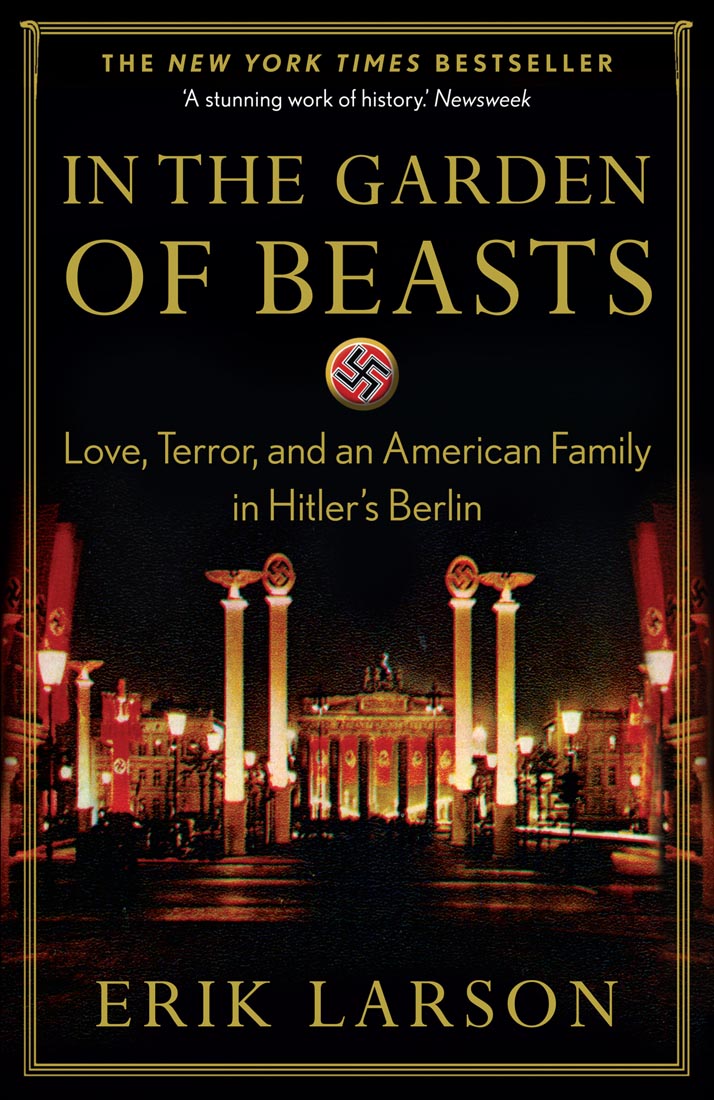
In the Garden of Beasts by Erik Larson

When our book club needed and "Narrative non-fiction" book, I immediately thought of Erik Larson. I've read his "The Devil in the White City" and "Dead Wake" and found both fascinating. So I suggested, In the Garden of Beasts by Erik Larson, and it was chosen.

After reading the first few pages, I realized that I has already read this book. That doesn't mean, however, that I remember it! But apparently I never blogged about it. An oversight on my part, about to be rectified.

This book chronicles the four-year ambassadorship of William Dodd to Hitler's Germany from 1933-1937. 

Dodd was an unlikely candidate chosen after all the obvious choices turned down the assignment. He was a history professor at the University of Chicago and not a wealthy child of elites. For his ordinariness, he was hated by those with whom he served. 

And yet, as Hitler consolidated power in Berlin, few elites around the world recognized the unique threat posed by his Nazi party. Dodd, who did all he could to wake the world to the threat and communicate his objections to Nazi rule, was usually ignored. It's incredible that an American, living "in the garden of beasts," with a front-row view of all that was happening could be systematically ignored and belittled. While Roosevelt seemed to believe Dodd, his hands appeared to be tied by a country and a bureaucracy willfully blind. 

The book seems to be the story of a possible missed opportunity while acknowledging that there was probably nothing to be done. Hitler's rise was inexorable given the world's desire to look away. No one, and certainly not a Cassandra-like, disrespected bureaucrat could convince the world to pay attention. 

While Dodd is the focus of the book, his adult daughter, Martha, takes up a lot of space as well. A pseudo-intellectual and self-described radical, she (literally) flirts with the Nazi regime. It took over a year for the bloom to come off that rose, even when confronted with the horrors of the government first-hand. Her promiscuity put her in bed (again literally) with some of the most powerful people in Berlin at that time. Both the Nazis and the Soviets tried to make an asset of her. In her left-wing naïveté she believed she could work effectively at... it's not clear. She loved being in the room with powerful people, but she left wreckage in her wake. Several deaths can be almost directly attributed to her presence in the victim's lives. She ended up exiled from America for communist activities. It took actually living in a communist country for her to disavow that particular affection. 

I think the biggest theme of the book is willful blindness and naïveté, both on the part of the world at large and in Martha in particular. Knowing the ending, it's particularly frustrating to read again and again of the obstacles placed in Dodd's path as he tried to warn the world of the coming war. Could he have stopped it? Obviously not. But it's tantalizing to imagine the, "What if...?"

Tuesday, June 20, 2023

Clarence Thomas and the Lost Constitution by Myron Magnet

Justice Thomas is one of my heroes. Not only is his one of those only-in-America type tale of rising from the very bottom to the very top, he has maintained a consistent ethos is the face of withering criticism. So when I heard about the book Clarence Thomas and the Lost Constitution by Myron Magnet, I immediately put it on my book "gift" list. Thankfully I received it one Christmas (or birthday). 

Myron Magnet uses the jurisprudence of Clarence Thomas to show the ways the Supreme Court has misinterpreted the Constitution and how Justice Thomas believes the errors should be rectified. Magnet identifies three specific items which endanger our republic: the misinterpretation of the 14th Amendment, the rise of the administrative state, and the doctrine of a "living" Constitution. 

Magnet spends time on the iconic background of Thomas, recounting his chaotic childhood and his subsequent life with his grandparents. Thomas' grandfather, in particular, looms large. Although Thomas rebelled for a short time against his grandfathers strict structure of integrity and hard work, and fell, himself, into grievance politics, today Thomas reflects the basic standards of fairness and decency, the love for and protection of liberty, as embodied in that man.

Magnet then asks the question, "Who killed the Constitution?" (33) It begins with the 14th Amendment. Originally passed to force states to recognize the rights of citizens previously only recognized by the federal government, the Supreme Court quickly began denigrating the very foundation of the law. In the 1873 Slaughter House cases, the Court rightfully asserted that the 14th Amendment gave the rights of citizens to blacks, but as far as the "privileges an immunities" guaranteed, those were highly limited. Rather than restate the clear meaning of the text written to address a clear problem of states not respecting the rights of black people, the Court held that the 14th Amendment only extended the rights of what was to be found exclusively in the federal domain: right to travel on interstate waterways and not be subject to ex post facto laws. This original misreading bears fruit to this day. Subsequent cases continued to let states off the hook for failing to protect the rights guaranteed by the 14th Amendment, leading inexorably to Plessy v. Ferguson and the "separate but equal" doctrine.

This judicial mockery of the clear will of the people played right into President Wilson's doctrine of a "living" Constitution. Frustrated at the roadblocks presented by the "Newtonian" Constitution of the Founders' design with its checks and balances, Wilson appealed to a "Darwinian" Constitution: one that every grows and evolves. Franklin Delano Roosevelt elevated this idea into a full-blown administrative state designed to regulate and dictate all levels of society. Initially rebuffed by a Court committed to a more proper understanding of the division of power, the recalcitrant court was threatened with court-packing and the judges switched sides.  

The idea that the government was no longer one of limited and enumerated powers found its apex in the mid-20th century. It begins with the Warren court and Brown v. Board of Education. Under the Constitution, the federal government had no role in education, but Justice Earl Warren, using the 14th Amendment as a pretext, found that its "equal protection" clause demanded desecrated schools. While this result is highly laudable, it created a "right" with no prior recognition. Rather than appealing to the clear language of the "privileges and immunities" guaranteed to all citizens, Warren sidestepped overturning Plessy, and invoked "equal protection" instead. In an ironic turn of events, future courts would use this same language, designed to make the government color-blind in regards to race, to advance race-based policies like Affirmative Action. It also allowed future courts to find additional "rights," no where enumerated in the Constitution, as they saw fit. Eventually rights would be found in the "emanations" and "penumbras" of the Constitution, forming a right to privacy, which was then interpreted to include a right to abortion.

Enter Justice Thomas:

The Constitution means not what the Court says it does, but what the delegates at Philadelphia and at the state ratifying conventions understood it to mean... We as a nation adopted a written Constitution precisely because it has a fixed meaning that does not change. Otherwise we would have adopted the British approach of an unwritten, evolving constitution. (61)

Thomas believed the Constitution was the ultimate stare decisis, or prior decision. It made no sense, in his opinion, to honor prior wrongly decided cases. As C.S. Lewis points out, if you find yourself on the wrong road, the most progressive thing to do is to turn around and go back. 

[T]o describe [Thomas'] fully mature method of constitutional interpretation more precisely: he begins with the plain command of the constitutional text or amendment in question, locates it in all the concrete complexity of its historical context, traces the historical process by which the command got distorted from its original meaning, explains the real-world consequences of that distortion, and points out how the Court can repair the damage going forward. His goal is a return to the framers' vision, aimed at protecting the liberty he cherishes as dearly as they did. (72)

We see this in his attempts to rein in a bloated administrative state, to replace a "living" Constitution with an originalist and textual approach, and a desire to reestablish a correct understanding of the 14th Amendment.

On this last front, Thomas combats the idea of "substantive due process," a legal doctrine that has become a catch-all for "whatever a judge wants it to mean." Magnet calls this idea, "smoke and mirrors...a hokey dodge around an old but incorrect, blood-soaked, and disreputable reading of the Fourteenth Amendment." (75) This doctrine, as opposed to plain old "procedural due process," claims that some rights are so fundamental that no state can withdraw them. What are those rights? Well the justices claim to know them when they see them. This has resulted in rights to education, marriage, privacy, abortion, and criminal rights, wreaking havoc in society as the government at all levels seeks to enforce an ever-growing list of rights no matter the outcome. Students have a right to an Olympic-sized swimming pool, drug dealers have a right to government-financed housing, thieves have a right to steal up to $950 in merchandise. At the same time, the government has a right to take property for any reason, the government has a right to regulate political speech, the government has a right to regulate anything and everything. 

Thomas traces the roots of all of this to a time when Americans abandoned the ideas of virtue and role models. People are no longer held accountable for their actions; echoes of Thomas' grandfather resound. The New Deal marked a turning point in American history with FDR's "freedom from want." Suddenly the government's job was to provide whatever you wanted and the Supreme Court's job became to find that particular "right" in the Constitution. 

As Magnet so eloquently puts it:

as people lose their veneration for the unalienable rights of mankind and their reverence for the active, heroic virtues that sustain them, the rights themselves crumble, government looms larger, the people feel themselves all the more powerless and dependent, allowing government to arrogate ever more power to itself, and so on, in a vicious circle. (120)

Clarence Thomas is fighting to end that doom loop by faithfully interpreting the Constitution.

Monday, April 10, 2023

The Gulag Archipelago by Aleksandr Solzhenitsyn

I had heard of  The Gulag Archipelago by Aleksandr Solzhenitsyn, and I absolutely love his speech, "Live not by Lies," so I had to read the book that made him famous.

I'm glad I did, but honestly, it's an odd book. Maybe because he's Russian, and he just has a different way of telling stories. The Russians can be bleak and seemingly accepting of whatever life throws at them. The story is not written necessarily in a chronological order. Nor does it even have what we would call a plot. It's written in vignettes and together they weave a tale of absolute horror. Yet the tone is mildly amused and sarcastic. I assume that to tell the story in a straightforward manner, would be overwhelming to both the author and the reader.

Solzhenitsyn begins with, "How do people get to this clandestine Archipelago?" (3) And the rest of the book is his journey to the prison after being unjustly arrested. He calls it an Archipelago because it's spread out all over the country. And it seems that no one really knows of its existence, as it is shrouded in mystery. 

One of the main points of the book is to make clear that however bad it may have seemed under the Tsars, enlightened and modern Soviet Russia was far worse. It seems that he worried people would not believe him. Perhaps the conditions faced by those arrested were not well known at the time. He tells the reader: 
What had been acceptable under Tsar Aleksei Mikhailovich in the seventeenth century, what had already been regarded as barbarism under Peter the Great, what might have been used against ten or twenty people in all during the time of Biron in the mid-eighteenth century, what had already become totally impossible under Catherine the Great, was all being practiced during the flowering of the glorious twentieth century--in a society based on socialist principles, and at a time when airplanes we're flying and the radio and talking films had already appeared--not by one scoundrel alone in one secret place only, but by tens of thousands of specially trained human beasts standing over millions of defenseless victims (94).

And yet, time and again, Solzhenitsyn returns to the idea that none is completely innocent. He recognizes in each human the capacity for the kind of evil perpetrated by the state."And just so we don't go around flaunting too proudly the white mantle of the just, let everyone ask himself: 'If my life had turned out differently, might I myself not have become just such an executioner?'" (160) 

"Pride grows in the human heart like lard on a pig" (163)

It is at this point that he makes his most famous statement, "But the line dividing good and evil cuts through the heart of every human being" (168). This is unbelievable grace from a man so wrongly accused. Humans, he states, must believe they are doing good. No one believes himself evil. Therefore a human will justify any level of cruelty. Ideology is the great justifier in the Soviet Union. Trying to understand the level of evil and its grip on humanity is one of the things I believe kept him sane.

Time and again, Solzhenitsyn details the sheet ridiculousness of the whole system. In the beginning, only one sentence was passed, ten years in prison, and all were guilty. Eventually other lengths were introduced--five-years, twenty-five years, death--but it was all random. Solzhenitsyn cautions his reader not to ask why he is being arrested. There is not an answer for that and there never will be. The arrest is the point. Stalin simply wanted to instill terror in anyone who may threaten him, real or imagined. To ask questions was to sentence yourself. To ask about a loved one was to be convicted as well. Women were brutally raped. Men had all their possessions stolen by roving gangs. Food was almost non-existent. Prisoners were kept in the most inhuman conditions imaginable. For what?

Every story is told with an ironic touch. Solzhenitsyn rejoices that only half the bread was moldy. O happy day! This jarring method of story-telling both reduces and increases the sheer horror of the situation. I believe he arrived at a place where, in order not to lose his sanity, he had to approach each fresh terror with a slightly crazy lens.

He tells stories which have been smuggled out from prisoner to prisoner of individuals and their plights. Many end badly or have no ending at all; The person simply disappeared into the jaws of the Archipelago. In one touching vignette, he describes one of his cellmates:

If the first thing you see each and every morning is the eyes of your cellmate who has gone insane, how then shall you save yourself during the coming day? Nikolai Aleksandrovich Kozyrev, whose brilliant career in astronomy was interrupted by his arrest, saved himself only by thinking the eternal and the infinite: of the order of the Universe--and of its Supreme Spirit; of the stars; of their internal state; and what Time and passing Time really are. (484)

Time and again, Solzhenitsyn offers his reader advice for how to survive the Archipelago. Divest yourself of all possessions. They will be taken anyways and you will only end up bloody in the process. "But by owning things and trembling about their fate, aren't you forfeiting the rare opportunity of observing and understanding?" (915) Cherish the moments when you see the stars or hear music. "Prison will become easier to bear. Otherwise you will explode from rage." (526) Understand the weight under which your jailer toils. He knows he will be joining you soon and it is that thought that drives the fear that drives his madness. 

As he finishes his journey and arrives at his destination, he concludes:

Shut your eyes, reader. Do you hear the thundering of wheels? Those are the Stolypin cars rolling on and on. Those are the red cows rolling. Every minute of the day. And every day of the year. And you can hear the water gurgling--those are prisoners' barges moving on and on. And the motors of the Black Marias roar. They are arresting someone all the time, cramming him in some-where, moving him about. And what is that hum you hear? The overcrowded cells of the transit prisons. And that cry? The complaints of those who have been plundered, raped, beaten to within an inch of their lives.

We have reviewed and considered all the methods of delivering prisoners, and we have found that they are all . . . worse. We have examined the transit prisons, but we have not found any that were good. And even the last human hope that there is something better ahead, that it will be better in camp, is a false hope.

In camp it will be . . . worse.

And yet, before the end, he sums up his advice:

Live with a steady superiority over life--don't be afraid of misfortune, and do not yearn after happiness; it is, after all, all the same: the bitter doesn't last forever, and the sweet never fills the cup to over-flowing. It is enough if you don't freeze in the cold and if thirst and hunger don't claw at your insides. If your back isn't broken, if your feet can walk, if both arms can bend, if both eyes see, and if both ears hear, then whom should you envy? And why? Our envy of others devours us most of all. Rub your eyes and purify your heart--and prize above all else in the world those who love you and who wish you well (591-592).


Monday, January 9, 2023

A Fiery Gospel by Richard M. Gamble

If I'm being honest, I wanted to read this book because it was written by a Hillsdale professor and the cover is beautiful! After reading A Fiery Gospel by Richard M. Gamble, I will never look at The Battle Hymn of the Republic the same way again!

Gamble tells a deeply researched story of the writing of the song by Julia Ward Howe. She was an eccentric woman convinced the she was on a mission from God. After visiting a Civil War Union encampment, she claims the poem the song is based on came to her fully-formed in a dream/vision. 

The real significance of the song, however, lies in the ways it was used after she penned it. The song has become a national anthem of sorts used by multiple causes to rally the faithful. With its apocalyptic and religious language, it appeals to those most fervent supporters of The Cause. 

All can claim the Lord is on their side. 

I have to say, the book now causes me to cringe when I hear the song. It really is pure propaganda. It's possible it's well-suited for the Civil War and the biblically epic narrative that war embodies, but today it has been used by anyone willing to appropriate it. 

Beautiful book. Interesting story. I'm glad I got to enter into this esoteric piece of history. 

It's too bad humans are what they are. 


Saturday, July 16, 2022

Nicomachean Ethics by Aristotle

Because it is such a classic, and probably an absolute must for classical educators, I decided to read the entire Nicomachean Ethics by Aristotle. I had read portions of it, and had watched the Hillsdale videos on it as well as heard Spencer Klavan on it. But it seemed time to actually read it. Besides, I had to read something floating in the pool. 

It was as good as I'd hoped. 

Aristotle can be tough. His overarching goal is to categorize everything. As he does this, his writing can seem repetitive and actually somewhat obvious. But it is his drilling down on definitions--on saying what something is, and what something is not--that causes us to see what we thought we already knew in a new light. 

Nicomachean Ethics proceeds Politics because Aristotle thought his students needed to know what exactly is the good at which they are aiming before embarking on a political program. That said, he begins Ethics with this familiar line:

Every art and every inquiry, and likewise every action and choice, seems to aim at some good, and hence it has been beautifully said that the good is that at which all things aim.

He is saying that everything we do is in pursuit of something we would call "good." It is therefore incumbent upon us to define this term. This preoccupies the rest of the book. 

Of course we could also say that we aim at "happiness" and Aristotle will explore this next. He creates a term, "being-at-work" for when a thing is its best self. When it is doing what it is made to do. This is "good." A tree, which is being as tree-like as it can, is a good tree. Human "beings-at-work" aim to be happy. And we can only be happy by aiming at the highest goods. Therefore only a good human is truly happy. A good human is one who has mastered the virtues to the extent he has internalized them and they define him. 

Therefore Aristotle proceeds to define the virtues. He shows that the virtues rest as a mean between two vices. Courage is between recklessness and cowardice. This does not mean that a virtue is exactly between them, but it is somewhere in the middle. The circumstances and our own natural proclivities will determine where the exact mean is. This makes it a difficult target to hit. Aristotle advises to overshoot in the direction that is hardest for you. If you are naturally cautious, aim for reckless and vice versa. In this way, you will hit closer to the virtuous mean than if you gave into your own natural desire. We become virtuous as we continuously do the virtuous thing. This is why it's important to know what that is. 

This brings Aristotle to the virtuous way of thinking. Humans make choices. And they make choices based on deliberation. Deliberation only involves subjects in which the particular human has some agency. In order to be virtuous, each person must deliberate and choose the most beautiful choice with the most beautiful of intentions. Repeating this process then leads to a virtuous person. Often, we are seduced into thinking that we can push the line in the small things, but when it counts, we will act virtuously. This is the opposite of what Aristotle wants us to see. Each deliberation, and therefore each choice, defines and builds our character. The kind of character needed to make the tough choice simply cannot be called into existence without practice.

When it comes to justice, Aristotle describes it as giving what is due. It is the most public of virtues and the one that requires all the others. Unlike courage, which can be done when called upon and doesn't need the other virtues, justice requires a virtuous way of thinking in order to understand what is actually due. Each situation is unique and requires serious deliberation and beautiful choices. Justice is the virtue of all other virtues. And once a man understands justice, he can make practical application and exercise practical judgment. 

Aristotle seems to go off topic when he dives into friendship. He categorizes friendships as those of utility--a relationship with an accountant--and those of pleasure--people who share a hobby--and those of virtue. This last form is rare. It is the friendship in which each person makes the other a better person. It's hard, but possible, among unequals. This is a friendship for the simple sake of the friendship. We are tempted to say that our friendships are of this sort. Yet Aristotle, as he is wont to do, reminds us that if we are complaining about a friendship, it is because it is not serving us. Therefore it is a friendship of utility. Ouch. I can see how most friendship fit into the first two categories. This makes sense. A virtuous friendship can only exist among virtuous people. Aristotle has spent the book so far showing how difficult that is. If there are two virtuous people, and they find each other, this must be rare.

Returning to his ideas of the "good," Aristotle calls us to be good humans. The end of the book makes clear that all this discussion of ethics is nothing more than a prelude to governing. He knows the men he is teaching will become law-makers and as such must know how to make good laws. He ends the book with, "So having made a beginning, let us discuss it." 

I love that this whole book was a prelude to the discussion of how best to govern a society. We rarely think about politics or politicians and say, "Well if you want to discuss that, we need to spend 10 or 20 hours discussing the good, virtue, wisdom, justice, and practical knowledge first."

Too bad. 


Friday, May 13, 2022

Les Miserables by Victor Hugo

Everyone has to read Les Miserables by Victor Hugo, once. I feel like a horrible person for saying that I didn't love it. It's VERY long. Way too long. Hugo describes the Battle of Waterloo in real time. He delights in describing the smallest details. Unfortunately, for me, that was a distraction that did not add to the story.

Obviously the main story is great. Jean Valjean's fall, rise, and fall are the reason the book touches so many. The interweaving stories of Fantine, Inspector Javert, and Collette point to so many big themes of redemption, mercy, and justice. 

If the book was about half as long, I know I'd love it. I hate that the details caused me to get so bogged down. 


Monday, July 29, 2019

A History of the American People by Paul Johnson

My favorite historian is Paul Johnson, and my favorite historical subject is America, so combined in A History of the American People by Paul Johnson, it is a thing of beauty!

Although a Brit, Johnson exudes love and support for America and all it stands for. In fact, his dedication reads, "This book is dedicated to the people of America—strong, outspoken, intense in their convictions, sometimes wrong-headed but always generous and brave with a passion for justice no nation has ever matched."

Johnson focuses on personalities and the associated events more than the "forces" and "trajectories" favored today. Also, he does none of the Zinn-style of telling history from the point of view of the disenfranchised or outcasts. Rather, he tells the story of those who actually made history and he is not afraid to pass judgment on them. This is one thing I love about his style. He freely acknowledges that these are flesh-and-blood humans with good and bad qualities, exercising their free will and making decisions that impacted history. Nothing is fore-ordained. People, not forces, shape history. And their legacy is fair game for fair judgment.

He does not begin his history with where many begin, pre-history and the Native Americans. He starts with the men we know who ventured to a New World to make something great. Christopher Columbus shows up on page one. It is not that the history of Native people is unimportant, but it simply plays little role in the foundations of America. And America's story is the one he's telling.

He begins by detailing Spanish exploration and then goes into the failure of Roanoke. Interestingly, and another reason to love Johnson as a historian, he gives as one reason for the failure the fact that it was an entirely secular effort with no religious dimension. Johnson, a devout Catholic, does not shy away from the role of religion in forming America. The theme will resurrect time and again. Yet his is not a jingoist story of America as a Christian nation, but simply one that has been informed and shaped by Protestantism. In telling the story of the Pilgrims, he details the desire for religions freedom and liberty. Yet, believing as they did that Catholicism shackles liberty, they defined liberty as the liberty to practice their form of religion. From the beginning we had a tension surrounding the definition of liberty, while making clear that it was a central American value.

The tension with liberty continued in the introduction of African slavery into the Carolinas and the treatment of Native Americans. England took little notice of either issue, leaving the colonies to develop their own systems and regulations as regards to both. Although the royal colonies had governors sent from England, the mother country was far more concerned with trade. By and large, the colonies were on their own. As such, they quickly developed different norms and customs, making each colony distinctly different from the others. But the Great Awakening came along, uniting the colonists in religious fervor and helping to create a distinct American.

The French and Indian War took the foundation laid by the Great Awakening and sparked a consciousness that would lead to Revolution. The victory by Britain produced a great empire and simultaneously saw a rise in incompetent and arrogant leadership. "It is now time to see the origins and progress of the breakdown between Britain and America through the eyes of a man who was involved in all its stages and did his considerable best to prevent it—Benjamin Franklin." (p. 134) This is where Paul Johnson shines. He uses real people and their lives to highlight historical events. In fact, I would argue that the close study of a few individuals would be enough to inform the average American of almost all the American history he needs to know. Johnson then shifts to a study of Thomas Jefferson as "the archetypal figure of the Entire Enlightenment." (p. 143) He's similar to Franklin in many ways, but a representative of a different class of people who would impact the American project. It was this man who would give us, "We hold these truths to be self-evident..." as the fledgling colony declared its independence from Great Britain. The next individual that requires careful study is obviously George Washington. From the time hostilities broke out until his death, he will be the central figure in the formation of a new and distinct America.

After winning the war, the question became how to govern this sui generis entity? "There is no question that the Declaration of Independence was, to those who signed it, a religious as well as a secular act, and that the Revolutionary War had the approbation of divine providence. They had won it with God's blessing and, afterwards, they drew up their framework of government with God's blessing, just as in the 17th century the colonists had drawn their Compacts and Charters and Orders and Instruments, with God peering over their shoulders." (p. 204) Yet the Constitution makes little mention of God. Johnson attributes this to a happy coincident of history. "As it happens, by a historical accident, it was actually drawn up at the high tide of 18th-century secularism, which was as yet unpolluted by the fanatical atheism and the bloody excesses of its culminating storm, the French Revolution." (p. 205) For a brief period of time, it was possible for a very religious people to form a government that neither mandated nor proscribed religion. Because of this, America has never had a religious war and continues to be have a healthy religious flourishing to this day. Johnson, a devout Catholic, is the rare historian who does not treat religious belief as an interesting artifact of a backward people. He believes in his subjects sincerity and understands it. This kind of understanding allows Johnson to make a brilliant defense of the original intent of the First Amendment. "This guarantee [of religious freedom] has been widely, almost willfully, misunderstood in recent years, and interpreted as meaning that the federal government is forbidden by the Constitution to countenance or subsidize even indirectly the practice of religion. That would have astonished and angered the Founding Fathers." (p. 209) Although wisely not incorporating a national church, the Founders understood that a self-governing nation was appropriate only for a religious and moral people.

Now America has to get on to the hard task of actually governing. Early presidents Washington, Adams, and Jefferson set the tone and structure of how the new nation would proceed. Alexander Hamilton, a most forward-thinking economic mind, would place the nations fractured economy on solid footing. In addition, the longest-serving Supreme Court justice, John Marshall, would outline the contours of the new judiciary. It is nothing short of a miracle that the men needed to guide the experiment were all on the scene at the same time. The fact that they had heated disagreements about the ends and means was even more beneficial as we needed all of them together to form a balance.

By the time we get to Andrew Jackson, America is more mature and ready to be unleashed from the elites that have guided her. He enters like a force of nature and forever alters the character and trajectory of America. A study of his life would again tell us so much of what we need to know about life in the early republic. He was born in 1767 and so was literally born into a revolutionary time. By the time he entered politics, he was a self-made man, able to take advantage of the freedoms offered in America. Unlike his predecessors, he was from the West and the first military hero since Washington. He ushered in unprecedented democracy and expansion, representing a young nation chomping at the bit to make something of itself. "Jackson thought the people were instinctively right and moral, and Big Government, of the kind he could see growing up in Washington, fundamentally wrong and immoral. His task, as he saw it, was to liberate and empower this huge moral popular force by appealing to it over the heads of the entrenched oligarchy, the corrupt ruling elite." (p. 329

A credit to its success is that America came to be described, by Benjamin Franklin, as a "happy mediocrity." Johnson says, "The fact that, unless we investigate closely, we hear so little about the mass of the population is itself a historical point of great importance, because it testifies by its eloquent silence to the success of the republican experiment." (p. 283) In the first half of the 19th century Americans got about the business pursuing happiness. Freedom was literally paying off. "Not only were American wage-rates high, but you kept your earnings to spend on your family. Then there were other blessings. no conscription. No political police. No censorship. No legalized class distinction. Most employers ate at the same table as their hands. No one (except slaves) called anyone 'Master.'" (p. 289) Prosperity allowed these early Americans to consider universal education. Horace Mann "opened the first 'normal' school in the United States at Lexington in 1839, and thence reorganized the entire primary and secondary education system of the state, with longer terms, a more scientific and 'modern' pedagogy, higher salaries and better teachers, decent, clean, and properly heated schoolhouses, and al the element of a first-class public school system." (p. 302) Although government-run education became problematic at the turn of the next century, a country that could afford to educate all its citizens was an unheard of luxury.

Into this growing, prosperous nation the issue of slavery remained to be tackled. The contradictions of freedom demanded an answer to the question of human chattel. The Founders recognized the inherit hypocrisy and predicted a war would result. Adams stated that "its result must be the extirpation of slavery from this whole continent and, calamitous and devastating as this course of events must be, so Glorious would be the final issue that, as God should judge me, I dare not say it is not be desired." (p. 319) But that predicted war would be delayed by compromise time and again until it finally broke in 1860, which allowed the nation to solidify the gains made by the Revolution and fight a war for freedom for all from a place of solid strength.

This strength came from Americans' belief in the greatness of their destiny. As one essay put it in 1838,
"The far-reaching, the boundless future will be the era of American greatness. In its magnificent domain of space and time, the nation of many nations is destined to manifest to mankind the excellence of divine principles: to establish on earth the noblest temple ever dedicated to the worship of the Most High-the Sacred and the True. Its floor shall be a hemisphere—its roof the firmament of the star-studded heavens—and its congregation the Union of many Republics, comprising hundreds of happy millions, calling and owning no man master, but governed by God's natural and moral law of equality, the law of brotherhood-of ‘peace and goodwill among men’." (p. 371)
Yet as de Tocqueville would note, slavery was a chain holding back those who practiced it. "'On both sides [of the Ohio River] the soil is equally fertile, the situation just as favorable.' But Kentucky, because of slavery, is inhabited 'by a people without energy, without ardor, without a spirit of enterprise.' He was led, he said, again and again to the same conclusion: leaving aside the slave states, 'the American people, taking them all in all, are not only the most enlightened in the world, but (something I place well above that advantage), they are the people whose practical, political education is the most advanced.'" (p. 391) Into this setting arrives Uncle Tom's Cabin, published in 1853, making the moral case for the abolitionist position. Not only did it help spark the Civil War, it probably kept Britain from coming to the aid of the South.

Of that event, Johnson states, "The civil war, in which are included the causes and consequences, constitutes the central event in American history. It is also America's most characteristic event which brings out all that the United States is, and is not. It made America a nation, which it was not before. For America, as we have seen, was not prescriptive, its people forged together by a forgotten process in the darkness of prehistory, emerging from it already a nation by the time it could record its own doings. It was, rather, an artificial state or series of states, bound together by negotiated agreements and compacts, charters and covenants. It was made by bits of parchment, bred by lawyers. The early Americans, insofar as they had a nationality, were English (or more properly British) with an English national identity and culture." (p. 423) America became America because of the Civil War.

I believe an interesting case can be made comparing slavery at this time to abortion today. Both sides are locked into their beliefs with little movement, yet I don't believe it will end in war. But as Abraham Lincoln said, the nation cannot stand divided. It will become all one thing or all another. Today we see what I believe is the pro-abortion's last, desperate gasp, just as slavery proponents became much more shrill and vociferous as they saw their strangle hold on other humans slipping from their grasp. "The aggressive message of the South was: slavery must be extended because it makes economic sense for America. But beneath this aggressive tone was the deep insecurity of Southerners who had no real moral answer to the North's case and knew in their hearts that the days of slavery were numbered." (p. 432)

Enter Abraham Lincoln. Here again, Johnson turns to an individual to tell the story of a nation. "It was because slavery made him miserable, and because he thought it was destroying the nation, not least the South, that Lincoln reentered politics and helped to create the new Republican Party, primarily to prevent slavery's extension. Looking back with the hindsight of history, we tend to assume that slavery was a lost cause from the start and the destruction of the old South inevitable. But to a man of Lincoln's generation, the South appeared to have won all the political battles, and all the legal ones." (p. 441) But Lincoln had powerfully put himself in the camp of liberalism and nationalism, two very strong forces in the mid-19th century. His Emancipation Proclamation sealed the legitimacy of the North's cause.

As a believer, once again, Johnson does not shy from the spiritual component of American history. "As against all these raucous certainties, there were the doubts, the puzzlings, and the agonizing efforts of Abraham Lincoln to rationalize God's purposes. To anyone who reads his letters and speeches, and the records of his private conversations, it is hard not to believe that, whatever his religious state of mind before the war again, he acquired faith of a kind before it ended. His evident and total sincerity shines through all his words as the war took its terrible toll. He certainly felt the spirit of guidance. 'I am satisfied,' he wrote, “that when the Almighty wants me to do or not to do a particular thing, he finds a way of letting me know it.' He thus waited, as the Cabinet papers show, for providential guidance at certain critical points of the war. He never claimed to be the personal agent of God's will, as everybody else seemed to be doing. But he wrote: “If it were not for my firm belief in an overriding providence it would be difficult for me, in the midst of such complications of affairs, to keep my reason in its seat. But I am confident that the Almighty has his plans and will work them out; and ... they will be the wisest and the best for us.' When asked if God was on the side of the North, he replied: 'I am not at all concerned about that, for I know the Lord is always on the side of the right. But it is my constant anxiety and prayer that I and this nation should be on the Lord's side. As he put it, 'I am not bound to win but I am bound to be true. I am not bound to succeed, but I am bound to live up to the light I have.'" (p. 471)

Once the war was over, America had a decision to make—how should the South be treated as it was brought back into the Union. One school of thought was that of the Radical Republicans, hatred and punishment. Second was the moderate Republicans who sought to bring the states back into the Union slowly, while working to guarantee Constitutional rights to the citizens of the South, Black and White alike. The third option, that of the new president Andrew Johnson, was clemency, pardon, and rapid normalization of relations. Of course the worst of all worlds happened. The South believed they were owed clemency but the Radical Republicans imposed a harsh Reconstruction. The moderates continued to push for Constitutional protections in the face of a racist president and a recalcitrant South.

Johnson sums up the heartbreaking results, "The South, its whites virtually united in hatred of their governments, hit back by force. The years 1866–71 saw the birth of the Ku Klux Klan, a secret society of vigilantes, who wore white robes to conceal their identities, and who rode by night to do justice. They were dressed to terrify the black community, and did so; and where terror failed they used the whip and the noose. And they murdered carpetbaggers too. They also organized race-riots and racial lynchings. They were particularly active at election-time in the autumn, so that each contest was marked by violence and often by murder. Before the Civil War, Southern whites had despised the blacks and occasionally feared them; now they learned to hate them, and the hate was reciprocated. A different kind of society came into being, based on racial hatred. The Republican governors used state power in defense of blacks, scalawags, and carpetbaggers, and when state power proved inadequate, appealed to Congress and the White House. So Congress conducted inquiries and held hearings, and occasionally the White House sent troops. But the blacks and their white allies proved incapable of defending themselves, either by political cunning or by force."(p. 506) Reconstruction proved a failure, setting up the United States and specifically the South for a century of racial tensions.

Meanwhile, the North was anxious to put the war behind it and rush forward. As Americans moved into the frontiers, the conflicts with the Natives became more pronounced. Johnson summarizes, "The Indians were not murderous savages, who ought either to be detribalized and assimilated completely (as scores of thousands indeed were), or exterminated, or penned up in remote reservations—this being the view of the vast majority of 19th-century American whites. Nor were they sophisticated-primitive innocents, living in utopian and preservationist communities, brutally disturbed by cruel and heedless invaders of European extraction, that being the view of 20th-century romantic historians of Indian history. The more they, and the white settlers who displaced them, are studied in detail, and without prejudice on either side, the smaller the differences between them appear. Both Indians and whites were living in the same, often harsh country, and trying their best to master it, in different ways." (p. 518) Johnson believes the issues that led to the biggest conflicts were the Indians extreme fragmentation and general belief in the tribe's superiority to all other peoples, and their attitude toward settled farming, which was viewed as effeminate. While many Native Americans assimilated and lived successfully in white America, those that did not, were hamstrung by these two characteristics. Once again, the solution, Reservations, like Reconstruction, simply preserved and extenuated a bad situation.

Yet despite the violence on the Frontier, the American economy expanded rapidly. While England had been first out of the gate with industrialization, America was determined to surpass the mother country. "Americans were conscious, in the 1870s, 1880s, and 1890s, that they were proud inhabitants of the world's wealthiest country, enjoying living standards unprecedented in the history of humanity. All around them they could see the thriving machinery and infrastructure of this wealth-creating process, and it was inevitable that the men who presided over this pul sating, throbbing, enriching system should inspire confidence and invite emulation." (p. 550) With a new class of "political mediocrities" Americans turned to the real movers and shakers, the men of extreme wealth, the entrepreneur class. Men like Andrew Carnegie, who rose to riches with a steel empire and gave half his wealth away, and money men like J.P. Morgan, who demanded absolute adherence to good character, found a place in the American's imaginations as archetypal heroes. Others like Thomas Edison and Louis Comfort Tiffany created beautiful and useful things as part of America's creator class. Culturally and economically, America was finally growing up and showing the world the way forward. Sadly, Johnson states, "That the United States, lifted up by an extraordinary combination of self-created wealth and native talent, became a great cultural nation in the second half of the 19th century is a fact which the world, and even Americans themselves, have been slow to grasp." (p. 585)

The extreme wealth and cultural progress was not without its detractors. Ironically calling themselves Progressives, this group sought to retard the growth and, well, progress of the American people. Horrified by the growing gap between the rich and the poor and convinced that government action was needed to level society out, socialism began to become attractive. Despite the fact the almost-monopolies of Standard Oil and U.S. Steel were creating cheaper and better products, do-gooders and muckrakers sought to break them up for the simple sin of being big. While becoming unimaginably wealthy themselves, the capitalists were bringing wealth and leisure possibilities to ordinary Americans. But the size of the companies and the extreme wealth generated were enough to attract those who wanted control for themselves.

Johnson summarizes the Progressives excellently, "The anti-bigness emotion, so characteristic of the decades between the Civil War and World War One--and becoming stronger with each—is worth looking at because it was unAmerican. It is necessary to distinguish between Populists, who aimed deliberately at the farming vote and agricultural prejudices, and Progressives, who tended to be highly educated intellectuals aiming at an urban audience… It has been argued that Progressivism was the hostile reaction of the educated middle class to the overwhelming power of Big Business, whose wealth and scale and lure elbowed them out of the political-economic picture entirely, or so they feared. Since the days of the Founding Fathers, the educated elite had guided, if they had not exactly run, the United States, and they felt their influence was being eroded by the sheer quantity of money now sloshing around in the bowels of America's great ship of state… careful [prosopographical] analysis shows that the great majority were solidly middle class, university graduates of old British stock... By 1900, however, a number of new political fashions had come together to constitute a broad-based educated left-gas-and-water (or municipal) socialism, which was worldwide, trust-busting, conservationism (anti-urban sprawl, pro-wilderness), health fanaticism, the notion of educated purposeful elites as ‘guardians of the people, which was shared by a wide range of elitists, from Walter Lippmann (1889-1974) to Vladimir Ilyich Lenin and Benito Mussolini, and literary and artistic bohemianism.'" (p. 609)

Despite the attacks on the national success, America continued to grow. By the time of avowed Progressive Woodrow Wilson's presidency, however, it was time for America to take the international stage. "Americans enjoyed a laissez-faire society which was by no means unrestrained but whose limitations to their economic freedom were imposed by their belief in a God-ordained moral code rather than a government one devised by man. The rise of rural Populism, the development of muckraking, the appearance in the big cities of middle class Progressivism, and, not least, the romantic reformism and altruistic nationalism of Theodore Roosevelt-all these were premonitory symptoms of change. And under Wilson the changes actually began to take place, hastened and accelerated by America's fortuitous involvement in a catastrophic world war which destroyed Old Europe forever." (p. 627)

This new maturity ushered America into the familiar territory of modern day. It was time, in the Progressive's opinion, for America to grow up and fulfill the utopian promise the reformers believed they had be given. "Gradually, the progressive intelligentsia, and the bulk of the Democratic Party, began to see a strong federal government, with wide powers of intervention, as the defender of the ordinary man and woman against the excesses of corporate power. The notion of the Public Sector (good; needs to be expanded) as opposed to the Private Sector (potentially bad; needs to be invigilated and regulated) began to take possession of the minds of the do-gooders. For this purpose, it was necessary for the state to expand its revenues. Therefore a persona income tax, especially if it possessed progressive characteristics, and therefore was income-redistributive as well as revenue-raising, was a desirable institution." (p. 636)

From the ability to impose their political will, the Progressives moved to the desire to impose on the morality of Americans with the ill-fated Prohibition amendment. Johnson provides a great analysis, "The imposition of Prohibition, and its failure, illustrates perfectly a number of important principles in American history. First, it shows the widespread belief in America that utopia can be achieved in the here and-now and the millennium secured in this world, as well as the next. Second, it indicates a related belief that ‘Americanization' can be achieved by compulsion and law. Third, it draws attention to a weakness in American public opinion and policy—a tendency to will the end without willing the means ('freeing the blacks was another instance).... Fourth, the utopianism inherent in Prohibition came up against the utopianism inherent in the rooted and active American principle that freedom of enterprise must be totally unrestricted." (p. 680) Lack of effective enforcement led to the failure of the effort to clean up America and it was quickly repealed.

The 20s brought Harding and his "return to normalcy." It also landed Calvin Coolidge in the presidency. "Like his predecessor Harding, only more systematically and of set purpose and belief, Coolidge was a minimalist politician. He thought the essence of the republic was not so much democracy itself as the rule of law, and that the prime function of government was to uphold and enforce it." (p. 713) He was an incredible administrator, fighting budget deficits with a vengeance. Together with Harding, they let the market crash in 1921 with no government intervention. Had his method been followed in 1929, some argue the Great Depression may have been nothing more than another roll of the business cycle. His minimalism allowed America to prosper in a way that was "real, widespread, though not ubiquitous, and unprecedented." (p. 718) Coolidge chose not to run again, even though he knew the country could have used his steady guiding hand during the market correction he saw coming. Being president simply taxed him too much and he was not up for another term.

And the market did correct. Herbert Hoover reversed course dramatically from Coolidge and pulled every government lever he could. FDR doubled down on these policies. Johnson makes a good case that while all reasons the Great Depression became "great" are complicated, it seems clear that FDR's interventionist policies probable lengthened what should have been a much shorter recession. "The 1929 crash revealed... the naivety and ignorance of bankers, businessmen, Wall Street experts, and academic economists, high and low; it showed they did not understand the system they had been so confidently manipulating. They had tried to substitute their own well-meaning policies for what Adam Smith called the 'invisible hand' of the market and they had wrought disaster." (p. 734) Roosevelt's policies were erratic and followed no clear, discernible ideology, injecting fatal uncertainty into an already tenuous situation.

But then came World War II. FDR was in his element as a war-time president. Although he had railed against business before the war, he begged for their assistance once war was upon us. Johnson believes, "America won the war essentially by harnessing capitalist methods to the unlimited production of firepower and mechanical manpower." (p. 781) America had literally been preparing her whole life for this moment. And in this moment, she shone.  The apotheosis of her power became the atomic bomb. Johnson convincingly shows how this weapon of mass destruction was the only thing that would actually make the world safe for democracy. Truman, a simple man of simple convictions, made the decision to drop them on Japan with a clear conscience, knowing it was the best way forward. This plunged the United States into the role of international policeman as we took up the mantle of keeping the forces of evil at bay. This Truman Doctrine, combined with the Marshall Plan, caused America to be looked at as the world's savior as well as making it an object of hate. No one likes to be a dependent, but America continues to provide and protect, knowing it is ultimately best for the world.

As America entered the peaceful and prosperous 1950s, Eisenhower took the helm. He seems to have deliberately downplayed his own genius for the benefit of the country. "George Kennan came closer to the truth when he wrote that on foreign affairs Eisenhower was a man of keen political intelligence and penetration ... When he spoke of such matters seriously and in a protected official circle, insights of a high order flashed out time after time through the curious military gobbledygook in which he was accustomed to expressing and concealing his thoughts. At public press conferences Eisenhower used his gobbledygook to avoid giving answers which plain English could not conceal, and often pleaded ignorance for the same reason. He was Machiavellian enough to pretend to misunderstand his own translator when dealing with persistent foreigners. Transcripts of his secret conferences show the lucidity and power of his thoughts. His editing of drafts by speechwriters and of statements by Dulles reveal an excellent command of English which he could exercise when he chose. Churchill was one of the few men who appreciated him at his worth, and it could be said that they were the two greatest statesmen of the mid-20th century.” (p. 829)

Johnson spends considerable time on Nixon and Kennedy. It was clear that the media had a favorite and they would use their influence to control the narrative. Nixon was to be the bad guy and Kennedy the messianic figure. Johnson show clear disgust with the unfairness, describing Nixon in glowing terms and reserving some of his harshest criticisms for Kennedy. "By all historical standards, Nixon should have been an American media hero. He was a natural candidate for laurels in the grand old tradition of self-help, of pulling yourself up by your own bootstraps. He came from nowhere. His family background was respectable but obscure. He worked his way through an unfashionable college. He had no money except what he earned by his own efforts. He had, to begin with, no influential friends or connections. His life was dominated by a passionate desire to serve in public office, sometimes masquerading as brutal ambition, and by his patriotism and love of country, which knew no bounds. He was an autodidact and voracious reader, always trying to better himself, intellectually as well as professionally. He combined this earnest cultural endeavor with solid campaigning and administrative skills, which brought him early and continuing success, and with a modest private life which was morally impeccable." (p. 847)

Of Kennedy, Johnson says, "Jack never had his father's insatiable relish for money, power, and corruption. Most of his life he simply did old Joe's bidding. As he put it, ruefully: 'I guess Dad has decided he's going to be the ventriloquist, so that leaves me the role of dummy." In one important respect, Jack rejected the family tradition. Money did not interest him and he never troubled to learn anything about it. It was not that he was extravagant. Quite the contrary, he was mean...But, if he was not interested in making money, in most other respects he happily accepted the family philosophy, especially its central tenet: that the laws of God and the republic, admirable in themselves, did not apply to Kennedys, at any rate male ones. Like his father, he dealt with gangsters, when he felt so inclined. From the start he was taught by his father that bluff, freely laced with money—or outright mendacity if need be-could remove all difficulties." (p. 849) Johnson goes after Kennedy on every level, referring to his drug addiction, womanizing, poor political decision, outright lying, and marriage of convenience to Jackie. He even bursts the bubble on JFK's most notable success, the Cuban Missile Crisis. Johnson is not entirely sure that Kennedy did not make a bad situation worse.

Upon Kennedy's death and beatification, Lyndon Johnson found himself unexpectedly president. Although he had coveted the job his whole life, getting it under these circumstances seems to have affected him. The corrupt, racist threw himself into preserving the Kennedy legacy with a series of social programs designed to end poverty and bring about the utopian ideals so desired by the original Progressives. While greatly expanding government outlays in what would eventually prove to be a colossal waste of money, he also expanded America's role in Vietnam. This ultimately led to his inability to run again and win his second elected term. 

His unpopularity opened the door for Nixon's reappearance. Unfortunately, the hatred of the press meant that all Nixon's mistakes and errors in judgment would be magnified. Even spying on rival campaigns, which was apparently de rigueur , would be turned into a Constitutional crisis, referred today as Watergate.

Ford took over, pardoned Nixon, but was left with a very hostile Congress. This led to what is actually a bigger crisis than a 2-bit bungled spying campaign, the fall of Vietnam. Although America had won the war, after Nixon's resignation, "Ford was obliged to look on helplessly while such freedom as a decade of effort by America had secured for the peoples of Indochina was removed step by step. As US military aid to South Vietnam tailed off from 1973, the balance of armed power shifted decisively to the Communist regime in the North. By the end of the year the North had achieved a two to-one superiority and, in defiance of all the accords carefully worked out by Nixon and Kissinger, launched a general invasion. Bound hand and foot by Congress, Ford felt powerless to act and simply made verbal protests. In January 1975 the whole of central Vietnam had to be evacu ated and a million terrified refugees fled towards Saigon. In an appeal to Congress, Ford warned: ‘American unwillingness to provide adequate assistance to allies fighting for their lives could seriously affect our credibility throughout the world as an ally.' Congress did nothing. At his news conference on March 26 Ford again pleaded with Congress, warning of a massive shift in the foreign policies of many countries and a fundamental threat ... to the security of the United States. Congress paid no attention. Four weeks later, on April 21, the Vietnamese government abdicated. Marine helicopters lifted American officials, and a few Vietnamese allies, from the rooftop of the US embassy in Saigon, an image of flight and humiliation etched on the memories of countless Americans who watched it on TV. It was indeed the most shameful defeat in the whole of American history. The democratic world looked on in dismay at this abrupt collapse of American power, which had looked so formidable only two years before." (p. 908)

It took the presidency of Ronald Reagan to restore America's faith in itself. He presided over a genuine economic expansion and a peaceful foreign landscape. Although the media had developed a taste for blood and so Washington became a constant source of scandal and rumor-mongering. Most good and decent people seem to be scared off from such an environment which meant that America got Bill Clinton at the top. Scandal followed him in all he touched, whether it was financial dealing, womanizing, or shady behavior in governance. 

Finishing his history in 1997, Johnson concludes, "It is appropriate to end this history of the American people on a note of success, because the story of America is essentially one of difficulties being overcome by intelligence and skill, by faith and strength of purpose, by courage and persistence. America today, with its 260 million people, its splendid cities, its vast wealth, and its unrivaled power, is a human achievement without parallel. That achievement—the transformation of a mostly uninhabited wilderness into the supreme national artifact of history-did not come about without heroic sacrifice and great sufferings stoically endured, many costly failures, huge disappointments, defeats, and tragedies. There have indeed been many setbacks in 400 years of American history. As we have seen, many unresolved problems, some of daunting size, remain. But the Americans are, above all, a problem-solving people. They do not believe that anything in this world is beyond human capacity to soar to and dominate. They will not give up. Full of essential goodwill to each other and to all, confident in their inherent decency and their democratic skills, they will attack again and again the ills in their society, until they are overcome or at least substantially redressed. So the ship of state sails on, and mankind still continues to watch its progress, with wonder and amazement and sometimes apprehension, as it moves into the unknown waters of the 21st century and the third millennium. The great American republican experiment is still the cynosure of the world's eyes. It is still the first, best hope for the human race. Looking back on its past, and forward to its future, the auguries are that it will not disappoint an expectant humanity." (p. 976)

My favorite historian has written on my favorite historical topic, the history of America. He has covered us fairly, "warts and all", and he evokes a genuine love of an extraordinary place.