Wednesday, December 12, 2012

The Closing of the Muslim Mind by Robert Reilly


I’ve been wanting to read The Closing of the Muslim Mind by Robert Reilly for some time after hearing about it on Dennis Prager’s radio show. It promised to explain the mindset of the Muslim world in way that would make sense of what we see coming from that part of the world. 

It certainly delivered!

This book is extremely comprehensive in its scope and history of Muslim thinking. It traces the roots of Islamic philosophy (specifically Sunni Islam) back to the 9th - 12th centuries. At the time that Islam came in contact with Hellenistic reasoning and thought, a decisions had to be made. Should Islam accept the rationalist thought processes introduced by the Greeks, or should they rely solely on the revelation provided by the Koran. 

The rationalist school, the Mu’tazilites, lost and the revelation-only school, led by al-Ghazali and the Ash’arites, won. The implications are staggering. 

“The Mu’tazilites differed from their opponents in their teaching that God has endowed man with reason specifically so that he can come to know the moral order in creation and its Creator; that is what reason is for. Reason is central to man’s relationship to God.” This position implied a dangerous ability of man to determine right from wrong on his own. Some Muslims began to question the Mu’tazilites for attempting to make themselves somehow equal to God. 

In their opposition to what they believed to be a dangerous heresy, the Ash’arites went in the exact opposite direction. “The autonomy of reason was anathema to them. Revelation was primary and supreme. In Ash’arism, as we shall see, the primacy of revelation over reason rises from the very nature of what is revealed: God as pure will and power.” However, this philosophy posits an irrational god that cannot be known. If God is pure will, He can will whatever He wants from day to day. In fact, the Ash’arites only believe God appears to be consistent because He acts out of habit. Man has no free will for to make our own decisions would be to negate the power of their god. And, as He is also pure power, might makes right in the very literal sense. There is no other way to change the culture and the people because rationality has been discarded. 

This very disorienting worldview, in its logical end, states that reality is an illusion. Because EVERYTHING happens as a result of god’s will, nothing else causes anything. So if I pick up a glass, I did not cause the glass to rise or even my hand to move. In fact, the atoms and molecules were rearranged by god at each millisecond and it only appears to have been caused by me. Similarly, if I shoot someone in the head, and they die, it was not I that killed them, but god. Had he wanted them to live, he would not have moved the bullet in such a way as to kill. He could also keep a headless person alive if he so wished. It is only the “habit” of Allah that leads to the death of a beheaded person. 

In this bizarro world, no real learning can take place. We can know nothing and to presume that we can is to usurp god and his ability to change the “facts” at any time. Obviously a worldview that eschews rationality and reality itself cannot survive for long in any kind of successful way. Is it any wonder that majority-Muslim nations are such basket cases?

Today, the Muslims have no desire to modernize and join in the post-enlightened world. Rather, they seek to destroy rationality in the world at large in the same way they have stifled it their nations. This can only be done through violence as power is what determines right. As we think of how to affect the Muslim world in a positive way, Reilly states, “The Middle East is poor because of a dysfunctional culture based upon a deformed theology...” It cannot be modernized or introduced to rational thought until its entire worldview ceases to exist. 

A world based on the lack of reason and reality is a world constructed in the very pit of hell. Who else but an evil mind could conceive of so damaging a theology. Muslims cannot know their god, nor can he love them. Both would be heretical notions of equality with their god. I’m so glad we have a God that says, “Come, let us reason together.” “For God so loved the world...” Is there hope for the Muslim world. Not much...

The differences produced in society by belief in these two very different Gods could not be more sharp. 

The Amateur by Edward Klein


The Amateur by Edward Klein gets it’s name from a rant Bill Clinton went on when trying to convince Hillary to challenge Obama for the 2012 nomination. After listing one area after another in which the current president had failed, “he bit his lower lip and scanned the faces in the room. He was plainly gratified to see that his audience was spell bound. They were waiting for the politician par excellence to deliver his final judgment on the forty-fourth president of the United States. ‘Barack Obama,’ said Bill Clinton, “is an amateur!’”

This book is a fast-paced, behind-the-scenes look into the Obama presidency. He interviews over 200 people, many of whom speak on the record. The details and style of the book make you feel as if you are a fly on the wall. I had a very hard time putting this book down!

Klein divides his book into five parts. 

The first part deals with Obama’s history coming up through Chicago. Since he made little impact in his work as a community organizer or part-time lecturer, those who knew him concluded that he was always looking for the next rung on the ladder and had little time for his present situation. He made some powerful friends and learned all about the art of politicking from this Chicago bunch. Many of them now complain of his over-sized ego and narcissism. He has left many of them in the dust as he moved on to bigger and better things. One that he left behind was his pastor and mentor, Jeremiah Wright. When asked if he converted Obama from Islam to Christianity, he replied, “It’s hard to tell. I think I convinced him that it was okay for him to make a choice in terms of who he believed Jesus is.” So much for “He’s a Christian, not a Muslim.”

The second part is called, “Amateur Hour at the White House.” One of Obama’s first acts as president was to call together a cabal of fawning historians to ask them how to secure his place in history as a dynamic and transformative president. Klein states, “It was by any measure, a breathtaking display of narcissistic grandiosity from a man whose entire political curriculum vitae consisted of seven undistinguished years in the Illinois Senate, two mostly absent years in the United States Senate, and five months and ten days in the White House. Unintentionally, Obama revealed the characteristics that made him totally unsuited for the presidency and that would doom him to failure: his extreme haughtiness and excessive pride; his ideological bent as a far-left corporatist; and his astounding amateurism.” 

All of these traits can be traced back to the real power behind Obama, Valerie Jarrett. She is the one pulling the strings and making the decisions that are supposed to be the president's. Obama rarely goes against her far-left judgment and she is responsible for the many bungled opportunities. She and Michelle are extremely jealous of anyone else who would seek to influence Obama and keep him highly isolated from even his Chief of Staff and Cabinet members. They run the show. This part of the book is the most fascinating and scary. We did NOT elect these women, and yet they pull the strings.

The third part of the book details the snubs and insulting behavior by Obama towards his supposed friends. It includes a chapter on the Michelle v. Oprah falling out (once again over jealousy of Oprah’s growing influence on Barack). His snubbing of the Kennedy family, his disrespect for the Jewish Community vis-a-vis his treatment of Israel, and his failure to address issues that disproportionately affect black, like the high unemployment. I believe he has taken them all for granted knowing none will vote Republican, and he is right.

Part four deals with his chaotic foreign policy. Apparently this is the area he takes the most ownership in. Who knew? He writes his own policy papers rather than the traditional method of delegating that to lower levels. He “makes the call of most every subject and with a degree of personal intensity.” The “Obama Doctrine” was hatched in the post-cold war leftism that sought to diminish America’s power in the world. He’s heavily influenced by Samantha Power who advocates a policy of mea culpa and humanitarian action. Yet this leads to a convoluted and random foreign policy of appeasing our enemies and capriciously acting when a “humanitarian” crisis presents itself. Of course, humans suffer all over the world for various reasons. Deciding when to become involved (i.e. “leading from behind” in Libya and ignoring Syria) has no apparent rational basis, but is emotionally driven. 

Part five is the most depressing as Klein makes the case for “A One-Term Proposition”. He reiterates Obama’s failure to grow the economy because he followed FDR and Ted Kennedy’s far-left ideologies, and the fact that he sunk deep into the mud as his reelection neared. He states, “To win reelection in 2012, Barack Obama must divert the country’s attention from his record of incompetence and amateurism.” Apparently he did just that.

I thought I would not want to read this book, knowing Obama would be reelected, but it kept me riveted and showed me even more forcefully that Obama is where he is because God is going to use his presidency to further His plan. Unfortunately, I believe God’s plan is to diminish America as “the last, best hope” so that ultimately people will look to Him when the world rips apart at the seams. Unknowingly, Obama appears to be doing the Lord’s work.

Friday, December 7, 2012

The Rage Against God by Peter Hitchens


The Rage Against God by Peter Hitchens details the story of how he rejected his faith and God and ultimately came full-circle to becoming a committed Christian believer. He references, at times, the journey his brother Christopher Hitchens took as well. While they started out on a similar path, being raised nominally in church then rejecting religion, they diverged when Peter started to question the assumptions made by his fellow atheists. This led to an understandably strained relationship for most of their adulthood.

He begins with his realization that most atheists seem to be in actuality, wounded theists. That is, they believe in God, until He disappoints them. Their atheism, then, is an attempt to get back at God by refusing to believe in Him.

He then traces the roots of his own particular atheism. It began in childhood, when he fancied himself much to smart to believe in what his stodgy elders believed. He was taken in by an elite that mocked religion, dismayed at the personal failings of believers, and passionate about embracing “science” which seemed to have removed the need for God. Unfortunately, his parents and society could offer him no reasons to believe. He watched his father’s stature decline and saw his country become disillusioned by Winston Churchill after WWII and he himself, along with much of the continent suffered from the after effects of the two World Wars. Death and destruction seemed to destroy any idea that a good God existed and watched over His people. 

As an adult, he travels the world as a reporter. Seeing first-hand the devastation wrought by the godless Soviet Union. He notices the yawning gap between the powerfully connected and the rest of society. He sees the coarseness and hopelessness of a godless people. He sees there and in a stint in Mogadishu how rapidly a society that rejects God and His morals can decline. An encounter with a painting entitled “The Last Judgement” brings home the finality of those who reject God and end up in forever tortured. Suddenly coming judgement feels real and he knows he will stand before God and answer for his arrogance. 

But more than fear drives him back to his faith. He recognizes a lack in his own life of meaning. The traditions and great oaths he encounters anew as he marries and baptizes his daughter reawakens a desire for beauty and holiness. Unfortunately, he believes he has returned too late. He recognizes that his generation of godless rebels has forever changed the church he remembers. As he traces the decline of Christianity in both Britain and America, he concludes, “[they have] inherited a society with Christian forms and traditions. [They do] not know what to do with them or how to replace them. Into this confusion and emptiness the new militant secularists now seek to bring an aggressive atheism.” 

In the second part of the book, he moves away from his personal narrative to “addressing the three failed arguments of atheism.” 

The first argument of atheists points to religious wars and conflicts being about religion and therefore religion, and by extension, God, is to blame for the bloodshed. After acknowledging that sometimes, religionist have come to blows over definitively religious issues, he traces the history of other various “religious wars” to show that most are simply man waging war against man for the garden-variety reasons of wealth, power and land. While reviling the religious for the slaughters, atheists never attribute the greatest evils perpetrated in human history, those of Mao, Stalin and Hitler, to their atheism. How they cannot see the link baffles Hitchens and leads him to conclude that the real target of these wounded theists is their irrational attack on Christianity, and they are not truly open to facts. 

The second argument he debunks declares, “It is possible to determine what is right and what is wrong without God.” He points to the beauty of a standard that exists outside of human control. We humans are not naturally selfless and good. This is made all too obvious by simple observation. Without a higher law, a higher being, demanding that we “love our neighbor as ourselves” we simply won’t do it. Not for very long. He continues on, pointing out the atheists NEED for a universe devoid of God. They simply cannot fathom having to answer to something larger than themselves and have therefore believed the lie that absolute truth and morality can exist without God. 

Finally he goes after the belief among atheists that “Atheist states are not actually atheist.” Yet he counters, “Utopia can only ever be approached across a sea of blood. This is a far greater problem for the atheist than it is for the Christian, because the atheist uses this argument to try to demonstrate that religion specifically makes things worse than they otherwise would be. On the contrary, it demonstrates that our ability to be savage to our own kind cannot be wholly prevented by religion. More important still, Atheist states have a consistent tendency to commit mass murders in the name of the greater good.” Religious people believe Utopia will only come about by God’s intervention. Atheists must take matters into their own, bloody hands.

The third part of his book describes “The league of the militant godless.” He begins by comparing the “silly” beliefs of a common peasant to the huge lie swallowed by the atheists. They continue to deny the evil perpetrated by their own in the name of Communism. He documents very convincingly the absolute rejection of God by the Soviet Union as well as their subsequent horrific acts. Atheists must necessarily see the Soviet Union and the evil it produced as the result of their militant godlessness. But they must reject God in their quest for more power. “If God is not dethroned and his laws not revoked, he represents and important rival to the despot’s authority, living in millions of hearts. If he cannot be driven out of hearts, total control by the state is impossible.”

In conclusion, he states, “The League of Militant Godless had done their work too well. In the names of reason, science, and liberty that had proved rather effectively, that good societies need God to survive and that when you have murdered him, starved him, silenced him, denied him to the children, and erased his festivals and his memory, you have a gap that cannot indefinitely be filled by and human, nor anything made by human hands.”

This book is wonderfully written and argued. The prose is beautiful and transcendent. The voice of Peter Hitchens comes through in an achingly haunting manner. He writes what may be a eulogy to all that is good. His brother died an unrepentant atheist. That may be, for Hitchens, that saddest fact of all. 

Sunday, December 2, 2012

Destiny of the Republic by Candice Millard


Although you might be told not to judge a book by its cover, that is precisely why I became interested in Destiny of the Republic by Candice Millard. The picture of... well I didn’t know who, but whoever it was on the cover as well as the fonts used in the title and subtitle reached out and grabbed me in the book store. So without even knowing what the book was about, I dived in. 

It turns out that in this case, you CAN judge a book by its cover. 

Millard weaves a fascinating tale of the assassination of President Garfield only a few months after his inauguration. She seamlessly slips back and forth between the stories of the assassin, Garfield, Alexander Graham Bell, and Joseph Lister (a proponent of antisepsis). 

While the assassin, John Guiteau, plots to regain a life of meaning and purpose, Garfield is unanimously chosen as the Republican presidential nominee - against his wishes. He chooses Chester A. Arthur as his Vice-President in order to placate the faction of the party that supported the spoils system. Arthur has been bought and paid for by Garfield’s biggest rival, New York Senator, Roscoe Conkling. 

At the same time, Bell and Lister are making scientific discoveries and opening up an entirely new world with the telephone and antisepsis to prevent germs from wreaking havoc on medical patients. Both face a skeptical public and both prove up the challenges they face. 

Guiteau, finally convinced that God has called him to kill the new presidents when his requests for patronage jobs go unheeded, believes he has found his calling for greatness. He shoots the unprotected leader, leaving him alive but now under the care of Dr. Bliss. Having been rebuffed earlier in his medical career, and having such an important patient, leads Bliss to reject the new-fangled germ theory. Wholly incorrect about the position of the bullet in the body of Garfield, Bliss and many other doctors probe the wound with ungloved, unwashed hands. 

Bell, remembering the noise his telephone lines emitted when near metal, determines to build the first metal detector in order to find the bullet lodged in Garfield. He races against time as Garfield grows progressively worse from the infection introduced by Bliss and the others. Although his machine works, it proves fruitless on the president because Bliss only allows Bell to scan the location in which he wrongly assumes the bullet to be. 

For the two months that Garfield suffers horribly, Vice President Arthur wills himself to be better than he has been. He breaks all ties with Conkling and the spoils system. He sees in Garfield a much better man than he has ever been and desperately hopes not to have to fill the shoes of such a great and beloved leader. 

Guiteau, convinced that when Arthur becomes president he will lavish Guiteau with gratitude, sits in a jail in which even the guards try to kill him. He clings to the notion that at any time, the Republicans will come to his rescue and praise him as a hero.

Finally, Garfield dies, and the nation plunges into grief. At the autopsy, it becomes immediately clear that Dr. Bliss and his ministrations are the cause the death. The hole, bored into Garfield’s back, not by a bullet, but by the doctor’s fingers became horribly infected, leading to sepsis throughout Garfield’s entire body. Nevertheless, it is Guiteau that will pay with his life. Bliss, never believing he erred and rejecting the compensation offered by Congress as insultingly little, lives the rest of his life in ignominy. 

The only silver lining to this tragedy is that upon Arthur’s ascendency to the presidency, he finally does away with the patronage system, replacing it with the civil service system we have today. No longer would government jobs be allocated based on political payback, but only according to merit. Garfield’s death made Arthur a better man.

Knowing very little about Garfield, other than the fact that he was president, this book introduced me to a great man. Since he was a devout Christian, I look forward to meeting him one day. 

Sunday, November 25, 2012

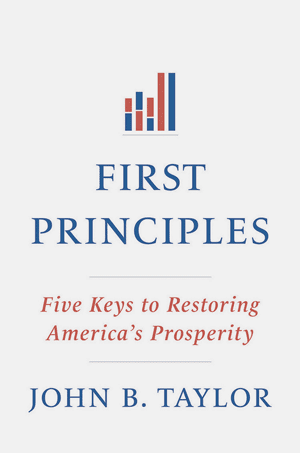
First Principles by John Taylor


I read First Principles by John Taylor because the book came recommended by Amazon based on my ratings. While I agree with its premise, it’s a little too wonky for me. I had hoped that politicians were reading and ingesting his book and principles. When I found out that John Taylor was an advisor to Mitt Romney, I felt heartened by the fact that he is apparently making headway into the top political circles. 

His Five First Principles are as follows:
Predictable policy framework
Rule of Law
Strong incentives
Reliance on markets
Clearly limited role for government

He goes on at length with an historical discussion of policies and administrations that have violated these principles and the resultant failure. Interestingly, it’s not always Democrats - bad and Republicans - good. The results directly correlate to an adherence to the first principles no matter which party is in power. 

His solutions include tax reform aimed at reducing our debt, reforming the Fed to follow sound monetary policy, not discretionary policies, end crony capitalism, reform entitlements, and rebuild American economic leadership.

The book details many specific policy prescriptions. I would love it if we could just hand this book to the Congress and say, “Do this!” We’d certainly be on the road to success if we are not already over the hump.

Wednesday, November 21, 2012

Implosion by Joel Rosenberg


Implosion by Joel Rosenberg makes the case that America will implode one way or another. Our economic and political problems are simply too entrenched to believe they will just go away or work themselves out. Although he presents both the pessimist’s case and the optimist’s case that we have faced tough times before and have always weathered the storm, because we must look at the problems we face spiritually to understand that America will, in fact, implode.

We are living in what the Bible calls, “the last days.” Jesus could return at any time and the rebirth of Israel was a very important sign that the time of the gentiles is coming to an end. However, America is not specifically mentioned in Biblical prophecy in the end times, so then, we have to ask, “Why not?” Joel lists four reasons he believes America may no longer be a world player in future prophetic events: 

1. Economic Implosion
2. Terrorist attack
3. Natural disaster
4. The Rapture

One has only to read Broke by Glenn Beck or any number of other books on the subject to see that America is quite possibly already too far gone economically. Serious economists are now calling for America to default on a debt it cannot possibly repay. Even if a solution is on the horizon, the fact remains that I believe we have very little time left on God’s timeline to repair the damage relying on government over God has caused. So possibility number 1 becomes a real likelihood.

The world is full of nations wanting to destroy America and they smell blood in the water. Americans are war and terror weary and are ready to let down the guard. A major attack by a hostile nation is certainly being planned and certainly possible. Even if we are not militarily attacked directly, we may become too isolationist and withdraw ourselves from a leadership role in the world. So possibility number 2 is also a strong contender.

The third possibility of a natural disaster knocking America off its perch is also a very real scenario. We have seen catastrophic disasters caused by earthquakes, storms, tidal waves and volcanos unleashed all around us in the last few years. Even Hurricane Sandy was said to be the “perfect storm” occurring as it did at the time of a full moon. California is ripe for “the big one” and such a possibility cannot be ruled out.

However, my prayer is that the United States is not a powerful player in the last days because we are decimated by the Rapture. Regardless of what else happens, the Rapture will severely disrupt life in America. Despite our spiritual failings, the Lord has preserved a vibrant remnant of His people. More people will disappear in single moment than have been lost in all our wars and natural disasters combined. The panic and hysteria caused by such a cataclysmic event cannot be understated. 

No matter which scenario plays out and no matter which order they occur, for I believe all to be likely, the fact is is that God is trying to get our attention. He is using economics, terrorism, and natural disasters to remind of us our absolute dependence on Him. The church is largely asleep and God is shouting, “Wake up!”

Our hope then, is a Third Great Awakening. Rosenberg traces the history of the First and Second Great Awakenings. The First led to our Revolution and the devotion of the people to a Biblical worldview. The Second led to a rebirth of our nation as it prepared the country to fight for its very life in the Civil War. Each began in dire times where God had been largely forgotten and the national sins were great. Each followed a period when devotion to God had tapered off considerably from earlier eras. We are ripe for a Third Great Awakening!

But will we experience God’s love and mercy poured out one final time before His return? I don’t know. I pray we will. It starts with me. I must first experience revival in my own spirit before I can participate in bringing it to the nation. 

While all the evidence suggests the implosion of America is imminent, we must pray that God will have mercy once more, though we do not deserve it. Until God tells us, like He told the prophet of old to stop praying for the country, because He has judgement planned, I will pray that the Lord will open the hearts and minds of my fellow Americans to their sin and folly. But first He must reveal my own sin and folly to me. 

Revival is our last, best hope.

Wednesday, November 14, 2012

A Nation of Moochers by Charles Sykes


I read a lot of books, but no book has made me as angry as A Nation of Moochers by Charles Sykes. In fact, I finished the book quite hopeless and feeling quite taken advantage of. I felt like a sucker for not mooching. Apparently everyone else has their hand out!

We, as a nation are becoming addicted to OPM (Other People’s Money). In fact, more and more people are taking from fewer and fewer makers. This appears to be increasing and we may, in fact, be near the tipping point of unsustainability. But in the mean time, we continue to transfer more and more money under the irrational belief that  it is all being taken from someone else. At some point, those who are not moochers will realize they are suckers and simply walk over and join the takers. Then what?

The first kind of moocher Sykes discusses is the dependent class created by feel-good liberals. When the underclass rioted, liberals gave them money. They bought them off to keep them from becoming violent, but instead created a permanent dependent class. And the pay off has skyrocketed. Forget basic needs. Cell phone, flat screen TVs, X boxes are all necessary to avoid “relative deprivation” in which the poor do not have have all the stuff the “rich” have. This very materialistic view of humanity, that stuff is what matters to a good and happy life, has led to dependent, miserable people. We have created incompetent people who learn helplessness. When a disaster strikes, and the government cannot help them (i.e. Katrina) they are ill-equipped to deal with the situation. 

But the moochers are not just low-income Americans feeding at the government trough. Corporate America has pulled up a seat as well. Hollywood, “farmers”, owners of beach-front property, General Electric, Realtors, the U.A.W. green energy firms, Archer Daniels Midland, and countless other business suck up sweetheart deals and tax breaks from the government to the tune of BILLIONS of dollars. 

Moochers are also public sector union workers. Sykes details in a maddening way why it’s good to work for the government. The salaries and benefits eclipse equivalent private sector work. The job security is almost unbreachable, and the pensions are bankrupting other workers who have nothing similar to fall back on. Once again, many of us are taken for suckers to be mooched off of. Interestingly however, when a state like Indiana made union dues voluntary, 95% of all workers opted out. That’s the death knell for unions and a way to introduce sanity into our public sector.

Then he moves on to the bailout moochers. Whether it is big banks, investment firms, or homeowners who bit off way more than they could chew, lots of people lined up for government handouts. Remember, it’s the frugal and prudent who are paying off the losses of the greedy risk-takers. They win, we lose.

At this point, Sykes zeros in on the “Middle Class Suckers.” We are the ones who play by the rules and get punished for it. In fact, in many ways, our country punishes work. He gave example after example of how it would actually make sense NOT to get married or NOT to take a better paying job when government benefits would be reduced. It would almost seem the system is designed to discourage work and self-reliance. Or rather it’s designed to encourage government reliance! Even the middle class of the future are a bunch of suckers. We are already mooching off them and they aren’t even born yet. We are sticking them our $16,000,000,000,000 debt. Suckers.

How to fix it? I don’t think his suggestions are realistic. He basically suggests changing the culture and making a fast cutoff of wealth transfers. No one wants to be the first to back away from the trough. Politicians need to learn to say, “No.” Maybe in an alternative universe, but here on earth, that will never happen. 

My solution is to return to the Constitution. Our government was founded by God-fearing men who knew the propensity for human failings. They recognized from the very beginning the desire of man to mooch. That’s why they severely limited the role of the government. All of the bailouts, crony capitalism, transfer payments, Social Security, Medicare, welfare, tax favoritism, all of it, all the moocher’s tools are unConstitutional. Until we return to self-governance under God, with a firm reliance on Him and not the government, we will continue to mooch and continue to head down the path of implosion. And we who are self-reliant and trust God and make wise decisions consistent with a Biblical worldview will continue to be treated as... suckers.