Monday, October 16, 2023

Ithaca by Claire North

I read Ithaca by Claire North because I saw it on a shelf of recommendation at the library and because I'm interested in the subject matter. It's fresh take on a very old story made it definitely worth it. It takes the Odyssey and flip it on its head. Rather than hear the story from Odysseus point of view, it shows us Penelope as seen through the eyes of Hera. 

The author does a good job delving into the complicated world inhabited by Penelope. She especially provides insight into the relationship with her son Telemachus and the threats he faced. She intrigues with the introduction of an "Egyptian" but we never really get the payoff. 

Penelope must prove her strength against mysterious invaders, while keeping the suitors at bay and not at each other's throats. The clock is ticking and her son is in the crosshairs. No word from Odysseus, her loyalty does not seem to be necessarily to him, as much as to keeping herself, her son, and her island alive. She seems to succeed to live another day, but so many questions remain.

That was one of the issues I had with the book. The ending was ambiguous and not fulfilling. Odysseus does not even return to banish the suitors. Who is the mysterious "Egyptian"?

I discovered this is part one of a trilogy. I'm interested to read the others. Hopefully the questions will be answered. 

Clair North has done a good job retelling an ancient story. Her narrator, Hera, is funny, irreverent, and smart. The language grates a little with anachronistic phrasing and jenky metaphors. But overall, a fun ride.

Thursday, October 12, 2023

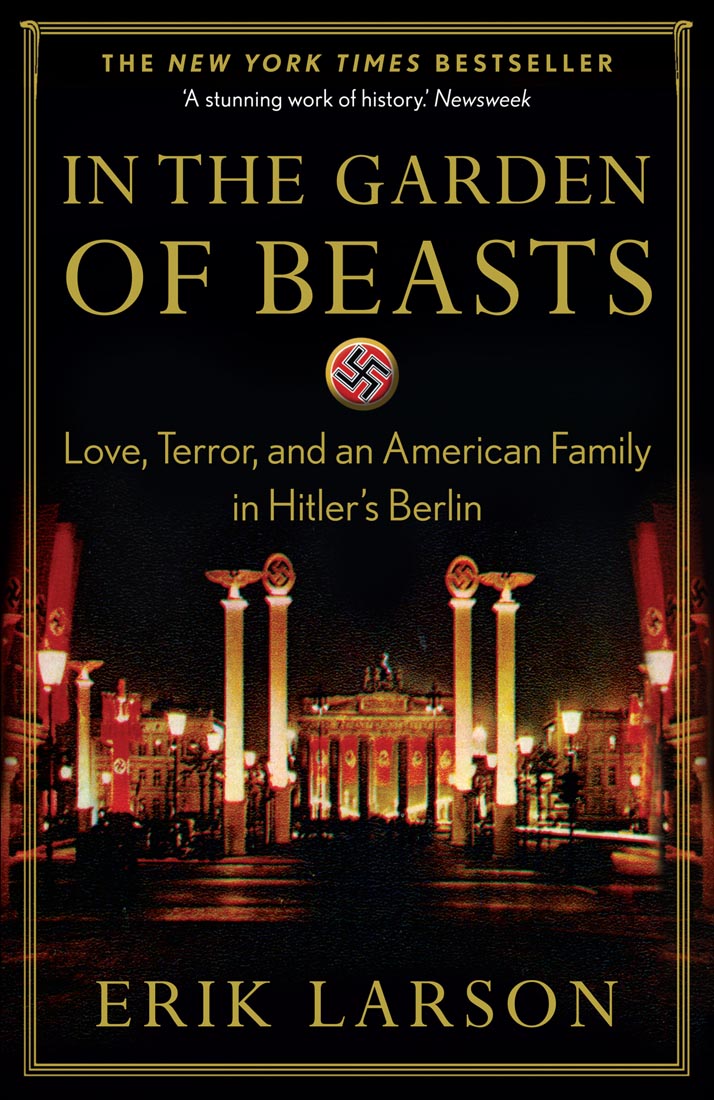
In the Garden of Beasts by Erik Larson

When our book club needed and "Narrative non-fiction" book, I immediately thought of Erik Larson. I've read his "The Devil in the White City" and "Dead Wake" and found both fascinating. So I suggested, In the Garden of Beasts by Erik Larson, and it was chosen.

After reading the first few pages, I realized that I has already read this book. That doesn't mean, however, that I remember it! But apparently I never blogged about it. An oversight on my part, about to be rectified.

This book chronicles the four-year ambassadorship of William Dodd to Hitler's Germany from 1933-1937. 

Dodd was an unlikely candidate chosen after all the obvious choices turned down the assignment. He was a history professor at the University of Chicago and not a wealthy child of elites. For his ordinariness, he was hated by those with whom he served. 

And yet, as Hitler consolidated power in Berlin, few elites around the world recognized the unique threat posed by his Nazi party. Dodd, who did all he could to wake the world to the threat and communicate his objections to Nazi rule, was usually ignored. It's incredible that an American, living "in the garden of beasts," with a front-row view of all that was happening could be systematically ignored and belittled. While Roosevelt seemed to believe Dodd, his hands appeared to be tied by a country and a bureaucracy willfully blind. 

The book seems to be the story of a possible missed opportunity while acknowledging that there was probably nothing to be done. Hitler's rise was inexorable given the world's desire to look away. No one, and certainly not a Cassandra-like, disrespected bureaucrat could convince the world to pay attention. 

While Dodd is the focus of the book, his adult daughter, Martha, takes up a lot of space as well. A pseudo-intellectual and self-described radical, she (literally) flirts with the Nazi regime. It took over a year for the bloom to come off that rose, even when confronted with the horrors of the government first-hand. Her promiscuity put her in bed (again literally) with some of the most powerful people in Berlin at that time. Both the Nazis and the Soviets tried to make an asset of her. In her left-wing naïveté she believed she could work effectively at... it's not clear. She loved being in the room with powerful people, but she left wreckage in her wake. Several deaths can be almost directly attributed to her presence in the victim's lives. She ended up exiled from America for communist activities. It took actually living in a communist country for her to disavow that particular affection. 

I think the biggest theme of the book is willful blindness and naïveté, both on the part of the world at large and in Martha in particular. Knowing the ending, it's particularly frustrating to read again and again of the obstacles placed in Dodd's path as he tried to warn the world of the coming war. Could he have stopped it? Obviously not. But it's tantalizing to imagine the, "What if...?"

Wednesday, September 13, 2023

Sense and Sensibility by Jane Austin

I enjoy Jane Austin for her biting social commentary and perceptive sense of human nature. Pride and Prejudice is a favorite. So I decided I had to read Sense and Sensibility by Jane Austin. Of course it's good. It's Jane Austin, but I didn't love it as much as Pride and Prejudice. 

The story involved two sister, each facing a similar loss of love. One responds with passion; the other responds much more sensibly. Like all Austin novels, the character can be a bit clichéd, but she's obviously patterning them on real people. 

I'm glad I read it. Now I'll have to watch the movie!
 

Sunday, September 3, 2023

Gentle and Lowly by Dane Ortlund

Our church decided to read Gentle and Lowly by Dane Ortlund in our Community Groups.

After reading it, my first thought was, "Why don't we lead with this?"

The book reflects the Puritan-style of explicating at length on a single verse. Ortlund has chosen Matthew 11:29: I am gentle and lowly in heart. 

Ortlund begins by reminding us that this is the only place in all of Scripture where Jesus talks about his heart. It might be good for us to start there.

This not one characteristic among many. It is not in tension or balancing out his wrath. It's who he is. 

Jesus IS gentle and lowly.

We see this time again in the gospels as he acts with love and humility towards ALL who sought him. The seeking him is key. Ortlund states, "This is not who he is to everyone, indiscriminately. This is how he is for those who come to him, who take his yoke upon them, who cry to him for help" (21). 

Jesus pronounces "woe" and judgement on the non-repentant. But to the sick, he is the Great Physician. 

In fact, in a very moving metaphor, Ortlund compares Jesus to a doctor working in third-world conditions. He is overjoyed when someone who is hurting and broken comes to him. He does not reject the patient or load him with guilt. He welcomes the chance to restore and to heal. That's who Jesus is. We, who come to him in repentance, are his joy. 

Not only is Jesus standing with open arms, ready to welcome the profligate home, he understands us. The beauty of a god who came to earth as a man, and suffered in every way a man can suffer, means he looks on us with compassion. He knows what it is to be in our shoes. He knows how hard it is to run from temptation. He's seen first-hand in those he loved failure. In fact, tied up in the word "gentle" is the understanding that he will deal with us perfectly. The deeper the anguish, the pain, the hurt, the brokenness, the sin, the gentler he becomes. He is there for us in the exact perfect way we need him to be. We cannot outsin his grace. It enlarges to encompass even our biggest failures. 

At the same time, Jesus understands the destructive nature of sin even better than we do. He, alone, sees the full damage caused by sin. Even in our most self-effacing moments, we fail to grasp the entirety of the damage done. In our fallenness, we will always color our repentance with some amount of self-justification. Jesus looks on our sin and knows it's worse than we thought. 

But rather than causing him to reject us, that knowledge of the depth of sin increases his compassion for us and his anger towards sin. He alone knows the havoc sin wreaks on his children. He will judge. But he will not judge the penitent. He already paid the price for our sins. Therefore when one takes up his offer of forgiveness, even with only a tiny glimpse of the damage done, his heart bursts with joy and love. That sacrifice has been made worth it.

And not only has Jesus paid the price in the past, he continues to make intercession for us today. Some see this as Jesus pleading for mercy from a harsh and retributive Father. This is not true. Jesus continuously brings us up to the Father and together they celebrate what he's done. Jesus is praying for us. And the Father is more than delighted to answer. Imagine that. He not only intercedes, Jesus is our advocate. He's on our side and he's making our case. This is his heart. 

He is a true friend. The most true friend we will ever have. He pursues us while allowing us to pursue him. And it is a two-way relationship. We have the honor to be his friend. Incredible. He knows every broken part, every shameful secret, every act of unfaithfulness, every betrayal. Yet he loves. He despises sin for its warping effect on us. He intercedes for us. He makes our case. His joy is when we come to him. And he calls us "friend." Not simply that we can regard him as a friend. He looks at us and says, "Friend." 

With all this focus on Christ, the temptation is to view him as "the good one." The Father is eternally indignant and must be pacified. The Spirit is around, but not doing much. This is so far from the truth. Everything that is true of Jesus is true of the Father and the Spirit. God the Father has the same heart. He, too, runs toward repentant souls with open arms. He does not need convincing. The Son advocates and intercedes because that is the job the Father gave him. The Spirit is the actual spirit of the Father. It is God. It's this loving, gracious, merciful friend in a form which can indwell us. It's God in us. Loving us and shaping us from the inside out. It's what makes God, God. It's the most intimate form of God. 

The heart remains the same. Yesterday. Today. And Forever.

From childhood, we are raised with a view of God as eternally angry, sitting high above in judgment, ready to pin us to the ground with thunderbolts. We are tolerated. We are perpetual disappointments. We are charity cases.

This is not the heart of God. 

He delights in a repentant child. He loves and welcomes sinners. The deeper the sin, the more grace to pour out on us. His greatest joy is to welcome us back into relationship with him. Think of the the Father of the Prodigal Son. He scans the horizon looking for the first sign of our return. And when we slink towards him, he runs towards us. He throws a party in our honor. That is the heart of God. 

Anger and wrath are his "strange work." Necessary, but not his natural bent. His love requires justice. He hates sin. He knows the vast extent of the damage sin does. He cannot allow it to continue. 

But his natural bent is love. We are his heart. His most natural desire is to embrace the repentant and rejoice. He must be provoked to anger. He naturally loves.

Why is this idea of God so strange to our ears. It's because we tend to see God as a bigger version of ourselves. We think, "If it was me, I'd be really mad. I might forgive, but I'd never forget." We anthropomorphize God. And we attribute our most sin-laden responses to him. How far off the mark is this! God, himself, tells us, "My ways are not your ways." He doesn't think or act like us. He's not just a better version of us, he's other. He responds in ways we can only hope for, but would never do ourselves. Our sinful nature justifies ourselves and condemns others. God has no sinful nature. He does not have vestiges of a sinful natures. He is not us, just redeemed. He is redemption. He does not need to justify himself, and he offers no condemnation to the repentant. This is simply not possible for a human. We cannot respond in this way. It goes against every fiber of our being. It goes with the grain of his being. It is God being most fully God. 

He is gentle and lowly. 

Ortlund ends with,

The world is starving for a yearning love, a love that remembers instead of forsakes. A love that isn't tied to our loveliness. A love that its down underneath our messiness. A love that is bigger than the enveloping darkness we might be walking through even today. A love of which even the very best human romance is the faintest of whispers. (168)

Christ offers us that love.


Friday, August 11, 2023

The Lord of the Rings by J.R.R. Tolkien

Our book club decided to read The Fellowship of the Ring, which is book 1 of The Lord of the Rings trilogy. I didn't love that first book as much as I thought I would. That could have been because I listened to the audio version and so may have been distracted. I decided to read the remaining two books and I'm glad I did.

I don't know what I can say about The Lord of the Rings. It's become so culturally prevalent, it's hard to add anything to the conversation. I've seen the extended version of the movies several times, and I notices the movies track along with the books pretty well. Even the twelve hours of footage, however, leave out a few scenes. I'll admit that having the visuals to refer back to helped me greatly as I read. Tolkien has a gift for description, but knowing the way the scene is portrayed in the movie and constant referral to the maps in the back helped tremendously.

What sets Tolkien apart from every other author is his ability to create entire universes in his head. Not only does he conjure up whole physical world, he brings to life an entire made-up history. His character have family trees and backstories. He refers to ancestors with the assumption that the reader has heard the story and needs the information as a point of reference. I have no idea how he does that! It makes the story so rich. It's not just the history and geography of an imagined place, but it's a world he, as a story-teller, asks us to enter into. Normal history  is not like that. The best historians can try to weave a tale out of the events and people who populate the past, but even the giants are stuck with myriad unfamiliar names and places which can make communicating a big story difficult. Tolkien has set up for himself the best of both worlds. He's a great historian telling a tale with enough extra-textual information to make it seem real, but no more than he needs to tell the story he is telling. Somehow, he manages to place all those details in service to a narrative involving two small hobbits. Do we need the entire hobbit geneology? No. Does it add richness and depth and a sense of reality if we do? Absolutely!

The book is long. My copy clocks in at 1178 pages including the appendixes, index, and maps (seriously, what fictional book has all that?!?). But do not leave life on this earth without immersing yourself in Middle Earth!

Saturday, August 5, 2023

East of Eden by John Steinbeck

Our book club decided to read East of Eden by John Steinbeck. I had been wanting to read this book since the summer of 2019, so I was pleased with the selection. 

In the past, I have not really enjoyed books by John Steinbeck. And although it took me a bit to get past the "And that's why I don't love Steinbeck" moments, I eventually got to a place where I loved the book.

The thing about Steinbeck that has always turned me off is his lack of nuance. He sees things in stark contrast. People are usually somewhat good or very bad. A situation starts bad and gets worse. He rarely lands in the little middle ground. Traveling from Oklahoma to California during the dust bowl is a frying pan to fire situation (Grapes of Wrath); Incredible luck will turn into incredible disaster due to the evil of men's hearts (The Pearl); Lenny must be killed humanely before the mob tears him to pieces (Of Mice and Men). Life is bad. People are the worst. The end.

That still existed to an extent in this book, but not entirely.

Obvious from the title is the concept of the battle between good and evil. And yet Steinbeck seems to be making the point that evil is not as evil as it seems and good is not as good. There's the nuance. He may be making the argument that Cain has been unfairly maligned. He ends with the idea that Cain always had a choice. That choice may have been constrained by events outside his control, but he had a choice.

In addition, I believe Steinbeck is pointing the spotlight back on the father (or possibly God, himself) in order to lay some of the culpability for Cain's sin on the Father. After all, God was the one who, through his seemingly irrational choice, put Cain in the position of having to resist the evil welling up inside himself.

This story is told in an intergenerational way. Two brothers, Adam and Charles (notice the "A" and "C" connection to Abel and Cain) are very different from each other and each struggles with a fallible father who both loves too little and too much. Later, Adam's sons, Aron and Caleb ("A" and "C"), also very different from each other, must navigate a complicated relationship with their own father. All four sons are in some way abandoned by a father intent on his own interests. 

Into this picture enters another family, the Hamiltons, who boast a wonderful father, and yet the children struggle in their own ways with living up to that great man. Steinbeck, the author, is the grandson of Samuel Hamilton, and has incorporated family lore into the fictional story. Is Steinbeck saying the father, whether good or bad, has little to no impact on his children? Maybe.

Adam's house servant, Lee, a Chinese-American, and therefore an outsider, plays the role of suffering savior. Although Lee has his own struggles, his life is subsumed under that of Adam and his boys. Lee, alone, sees the bigger picture and is imbued with wisdom. Yet even Lee cannot straighten the crooked path people have embarked upon. It is Lee who discovers the secret to the Cain and Abel story: Cain did not have to kill his brother. God warned him to choose wisely. 

The final important character is Adam's wife and Aron and Cal's mother, Kate. Adam has tried to redeem her with his love, but she will have none of it. She is the town whore and plays the role of pure evil. 

All the parallels to Scripture make it impossible to understand the story apart from that. Themes run throughout of original sin--Caleb struggles with his parentage; Adam's father is a self-centered con and a liar--Freewill--to what extend do the "bad" sons like Charles and Cal have the ability to be good--and what does it even mean to be good; Aron is the "good" son yet spends his whole life believing himself bad; The truly evil Kate has no such compunctions. The reader simply cannot get away from the biblical story of the Fall.

This is complicated book, yet Steinbeck's heavy touch makes it a bit cartoonish. I, however, really enjoyed it. I think Steinbeck has a lot to say. I believe he feels God put Cain in an impossible situation and then gave him a meaningless "choice." Human fathers, according to Steinbeck, do the same, but their human sons still have an ability to make a meaningful choice. I believe that in Steinbeck's estimation, an imperfect human father is better than a capricious heavenly one. Clearly, I don't believe that God forced Cain into an impossible situation; I do not attribute malice to God in the narrative of the murder of Abel. But I do believe humans are complicated. We can seem backed into a corner with no ability to make any kind of a meaningful choice, and yet I believe we always have a choice.

In the end, I think Steinbeck wrote East of Eden in order to redeem Cain. Does he succeed? Well, I suppose so, in the scripted world Steinbeck has constructed. I'm not sure how much the real world reflects Steinbeck's, however.


Wednesday, July 19, 2023

The Death of Learning by John Agresto

I saw this book recommended somewhere, and since it's about education, my interest was definitely sparked. The Death of Learning by John Agresto details the decline of the study of the liberal arts and his plan to restore it to prominence. 

He first defines the liberal arts as, "the seeking of knowledge about important matters through reason and reflection" (20-21). It's the type of studies that make humans particularly human and free us to think for ourselves. The study of the liberal arts should most naturally lead to the study of the truth.

But today's society has declared that kind of an education superfluous. It might be nice to delve into the complexities of life, but how is one to make any money doing that? Therefore, it is incumbent upon the defenders of liberal education to argue for the value the liberal arts give to both the individual and society in general. 

And yet, the humanities have been thoroughly muddled up with ideas like, "think like a historian," in trying to prove itself  a career-promoting option. Rather than give students an opportunity to simply sit at the feet of the masters, the liberal arts has attempted to make itself what it routinely decries: practical. 

If, however, we were to advocate for a full-throated version of the liberal arts, what would it include? Our multicultural landscape demands it not just be "dead, white males." So how to choose? Agresto suggests the following: "Thus, we could finally ask what was it that caused the notion of human liberation to flower—what ideas, writings, religious principles, or events brought about these current views of human equality, individuality, and freedom that so many contemporary believers in liberty, liberation, and equality cavalierly take as true. This would be the wonderful fruit of a real liberal education—one that seeks insight in books, reason, and arguments rather than weakly standing on slogans." Choose the best on offer. 

One big problem facing this kind of education is the fact that where it is still being attempted, it is being done badly. "Liberal education is no longer the attempt to understand the complexity of the universe and our own place in the cosmos, or even to understand our own civilization or truly learn about other cultures. It is no longer the introduction to the excitement of good novels and the ability to be moved or even transformed by the beauty of fine poetry. It is, instead, a type of badgering of incoming students, feeding them not questions but prescribed answers." It has become another of its antithesis: indoctrination. 

In order to move forward on this admittedly hard journey to restore the place of the liberal arts, Agresto first asks the reader to be clear-eyed about what exactly the liberal arts hope to accomplish. "I have never been convinced that liberal education necessarily makes one more charming or even more moral. However, I think it does hold the potential to make us smarter than we were before and more knowledgeable about things that matter. The aim of liberal education has never been softness of spirit but rather toughness of mind." In a sense, the study of ancient authors provides a way to make them immortal, almost magically immortal, by allowing us access to the minds of the dead. Any resultant virtue obtained is on us.

So what mindset should we bring to these precious texts? Agresto warns, "All too often to read critically means to approach a text looking for biases or errors, or at how little the author knew compared to us. But think how much better it would be to approach a text as if we are the ones with prejudices and half-formed opinions. To see that the bias might be with us, the readers and professors. To grow in learning means that we all have to be open to that"(144). We are not to criticize the text so much as allow it to criticize us. We approach with wonder, knowing we are in the presence of a towering intellect. After "trying to comprehend...everything relevant we can know about a writer, ideas, or events" can we properly begin to criticize as we move together towards truth (145). 

The self-governing republic bequeathed to us by our Founders requires citizens who can think, if we are to remain free. 
the liberal arts, properly conceived and taught, can introduce our students to the best thinkers, authors, and artists from antiquity to the present, how it could give students exposure to what would be, for them, new ideas and perspectives, and how it can offer them the chance to think through these matters for themselves and come to their own conclusions through reason and reflection.
This might cultivate the ability in them to possess their own minds...This is among the most weighty arguments for liberal education: The freedom to think, to imagine, to question, and to dissent is part of what it means to be a free man or woman. (150)
Inherent in a citizen of a self-governing nation should be both courage and humility. Reading the greats, properly done, can inculcate both. Best of all, it may lead to that most maligned of virtues: moderation. 

Agresto concludes his small book on a big topic like this:
My guess is that, for the liberal arts to live and again prosper, we will have to show that there can actually be an American liberal education--one that helps civilize all of us by preserving the finest in our culture's literature, art, music, and philosophy and that offers them all students; one that encourages all students to understand the basic principles of science and its marvels so that they can be intelligent citizens in our highly scientific and technological world; one that does not see itself as educationally separate from our colleagues in business, law, agriculture, engineering, and other technical and productive studies but that offers what it truly knows and which, in turn, looks to be open to education from them; one that helps this country understand itself and the principles that undergird it; one that has regard for the qualities of our fellow citizens and has the desire to improve their lot and not merely criticize it; and perhaps above all one that makes us smarter in areas that really matter. That is, an American liberal education that satisfies the Founders' hopes that this nation's citizens would be so knowledgeable about history, so cognizant of their duties, so intelligent about the alternatives, and so thoughtful regarding the principles that give life to the country, that indeed, as Madison said, liberty and learning would continue their high task of giving faithful support each to the other (174)